
Openreach PIA — S006 Underground Survey Training
Openreach PIA S006 Underground Surveying
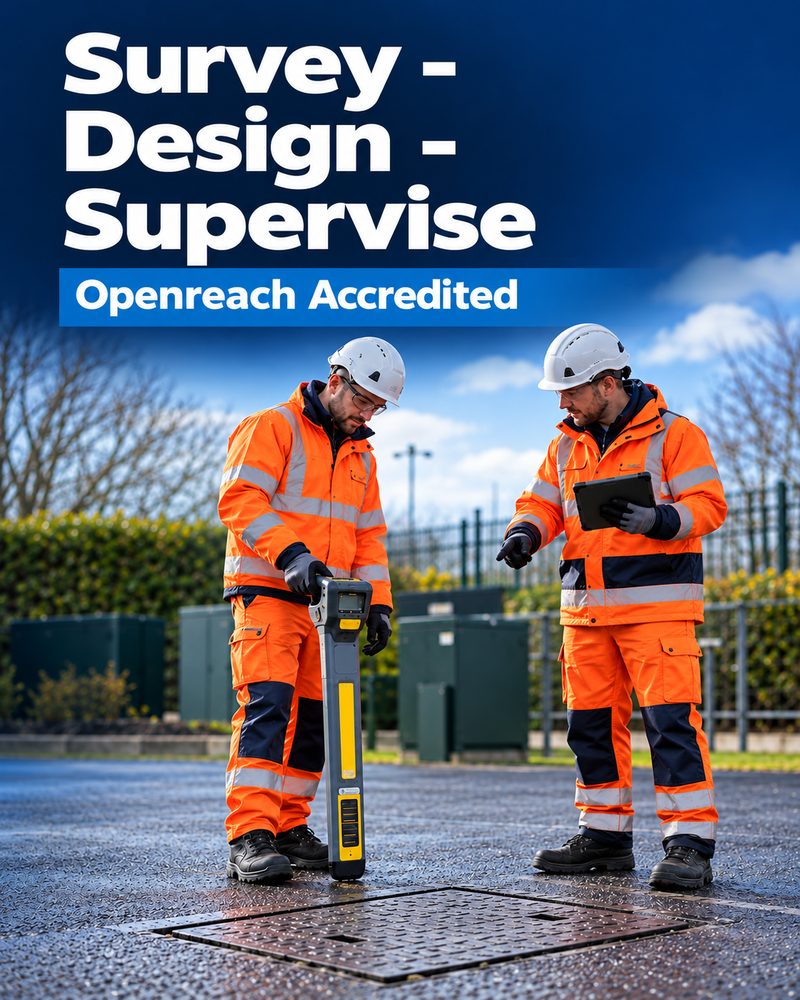
Develop practical skills in surveying Openreach underground infrastructure for Physical Infrastructure Access projects. This Openreach PIA S6 course, formally S006, builds your confidence in identifying chambers and ducts, assessing route constraints, interpreting mapping information and recording reliable survey findings. Learn to use underground locating equipment and distinguish confirmed observations from matters requiring further investigation. Training combines classroom instruction with practical surveying exercises at our centre in Crewe, Cheshire, followed by the required theory and practical assessments for S6 / S006 accreditation.

Loading available course dates…
Choose your date and book
Renew your Openreach PIA accreditation
Refresh your existing Openreach PIA accreditation before it expires. Refresher training is available to eligible delegates within three months of their accreditation expiry date.
£200 + VAT
Checking available refresher dates…
Course at a glance
Theory and practical, hands-on training
1 day
Duration
Fibre Optics Training Centre
Crewe, Cheshire
CW1 6BG
Location
Surveyors, planners and engineers surveying underground routes.
Who it’s for
Openreach PIA S6 / S006 accreditation
Valid for three years
Qualification
What you will be able to do
By the end of the course, you should be able to:
✓ Explain how an underground PIA survey supports route assessment, network planning and subsequent installation decisions.
✓ Review a survey brief and identify the information, access arrangements and checks needed before starting work.
✓ Recognise underground telecommunications chambers, ducts and access points, and describe their relationship to the proposed route.
✓ Distinguish Openreach infrastructure from assets belonging to other Communication Providers when gathering and reporting survey information.
✓ Compare Openreach mapping and available network records with site observations, identifying discrepancies that need further investigation.
✓ Identify relevant underground hazards and apply the safe working principles covered by your prerequisite training.
✓ Use underground locating equipment appropriately during survey activities and recognise the limitations of the information it provides.
✓ Assess chamber access, existing infrastructure and practical conditions that may affect the proposed underground route.
✓ Recognise possible duct blockages, restricted access and other constraints requiring investigation or specialist support.
✓ Apply the underground survey and testing methods covered during training to gather useful evidence for route assessment.
✓ Distinguish confirmed findings from assumptions, incomplete information and issues that cannot be resolved during the survey.
✓ Record infrastructure locations, route observations and identified constraints clearly so another person can understand the findings.
✓ Prepare survey records that explain both the conclusions reached and the limitations of the assessment undertaken.
✓ Communicate relevant findings to planners, designers and installation teams, identifying matters that require review before work progresses.
✓ Demonstrate the knowledge and practical surveying skills required to complete the Openreach PIA S6 / S006 assessments.
Course modules and practical training
This Openreach PIA S6 course combines theory with practical duct surveying, developing the infrastructure identification, route assessment, mapping and reporting skills needed to support Physical Infrastructure Access network planning.
Understanding underground infrastructure and PIA surveying
Explore the purpose of an underground survey and how it supports network planning, route selection and proposed fibre deployment. Consider the relationship between chambers, ducts, access points and the wider telecommunications route. Learn why a survey must provide useful evidence rather than simply repeat mapped information, and how the formal S006 duct survey accreditation relates to the responsibilities of surveyors working on Openreach PIA projects.
Survey preparation and safe working
Review the survey brief, available records and planned activities before attending the site. Consider access arrangements, underground hazards and the controls relevant to the work being undertaken. Relate survey preparation to your existing SA002, SA002A or SA006 training and recognise the limits of your competence. Identify circumstances that require clarification, additional controls or specialist support before the survey can proceed safely and produce reliable information.
Openreach and Communication Provider asset identification
Develop a structured approach to identifying underground telecommunications assets and recording what is present along a proposed route. Distinguish Openreach infrastructure from assets belonging to other Communication Providers where the available evidence allows. Consider how clear descriptions, locations and observations support later review. Learn to flag uncertainty about ownership or infrastructure identification rather than presenting an assumption as a confirmed finding within the survey record.
Chambers, ducts and underground network features
Examine the underground infrastructure relevant to PIA surveying, including chambers, ducts and the access points connecting different parts of a route. Consider existing apparatus, practical access conditions and the information needed to describe each inspected feature accurately. Develop confidence in explaining how individual observations relate to the wider proposed deployment, while recognising that a limited inspection may leave questions requiring further checks before a route assessment can be completed.
Openreach mapping and site information
Use available Openreach mapping and network records to prepare for survey activities and understand the proposed route. Compare recorded information with practical observations, identifying missing features, discrepancies and matters requiring clarification. Consider why plans must be interpreted alongside site evidence rather than treated as proof of current conditions. Practise recording differences clearly so planners and reviewers understand what was checked and which information remains uncertain.
Underground locating equipment and survey observations
Explore the use of underground locating equipment during the surveying activities covered by the course. Consider appropriate preparation, equipment use and the interpretation of observations within the survey task. Learn to recognise the limits of locating information and the need to relate it to other available evidence. Record findings carefully, explaining what the observation supports and avoiding conclusions that extend beyond the checks actually undertaken during the exercise.
Route suitability and duct survey constraints
Assess the conditions that may affect a proposed underground route, including restricted access, existing infrastructure and possible duct blockages. Distinguish a confirmed constraint from a potential concern that requires further investigation. Consider how incomplete information affects confidence in the route assessment and the actions needed before planning progresses. Develop practical judgement about reporting concerns accurately without assuming that an unverified route is ready for installation.
Underground survey and testing methods
Apply the survey and testing methods covered within FOT’s S006 training to gather evidence about underground infrastructure. Consider the purpose of each activity, suitable preparation and how its observations contribute to the overall route assessment. Relate practical findings to the original survey brief and identify checks that cannot be completed within the available access or authorised scope. Explain the limitations of a result alongside the information obtained.
Survey records and underground audit evidence
Bring infrastructure descriptions, mapping comparisons and practical observations together into a clear survey record. Learn to separate confirmed findings from assumptions and identify unresolved questions, access restrictions and suggested follow-up actions. Consider the information a planner, reviewer or installation team needs to understand the conclusions without repeating the survey simply to interpret the report. Maintain traceability between the observations recorded and the route assessment presented.
Reviewing findings for network planning
Review the completed survey information against the project brief and consider whether it provides a reliable basis for the next planning decision. Check that important constraints, discrepancies and limitations have been explained clearly. Identify matters requiring additional investigation or specialist review before a proposed deployment progresses. Practise communicating findings in a way that helps other teams understand both the available evidence and the remaining uncertainties affecting the route.
Practical surveying exercises and assessment
Work through practical underground survey activities that connect preparation, infrastructure identification, mapping, locating equipment and route assessment. Gather observations, explain identified concerns and prepare a useful record for review. Receive feedback on the reasoning behind your conclusions and the clarity of your reporting. Complete the required knowledge and practical assessments to demonstrate the competence needed for Openreach PIA S6 / S006 accreditation; attendance alone does not achieve the award.
On successful completion of the required knowledge and practical assessments, delegates achieve Openreach S006 – PIA Duct Survey, Network Underground Testing and Audit accreditation, commonly referred to as Openreach PIA S6 Underground Surveying.
The assessments demonstrate your understanding and practical ability to identify underground infrastructure, interpret mapping information, assess route constraints and record useful survey evidence for Physical Infrastructure Access projects.
Delegates must successfully complete all required assessment activities. Attendance alone does not achieve accreditation, and separate competence requirements apply to installation work and other specialist activities.
The Openreach PIA S6 / S006 accreditation is valid for three years from the date of successful completion.
Assessment and qualification
Who should attend?
This Openreach PIA S6 course is designed for surveyors, planners and experienced telecommunications personnel whose duties involve underground infrastructure surveys. It combines practical duct surveying with the observation, route assessment and reporting skills needed to support Physical Infrastructure Access projects and informed network planning.
This course is suitable for:
Telecommunications surveyors assessing chambers, ducts and existing underground routes for proposed fibre network deployment.
Fibre network planners and designers who need reliable underground survey evidence to inform route selection and infrastructure decisions.
Openreach PIA surveyors developing or refreshing their underground asset identification, route assessment and reporting skills.
Engineers and contractors responsible for identifying access constraints and recording conditions along proposed telecommunications routes.
Broadband and FTTP planning teams comparing mapping information with site observations before progressing network designs.
Technical personnel moving into underground survey responsibilities who already hold the accepted safety training and a valid NOPS card.
Project engineers reviewing survey findings and identifying issues that need clarification before installation work proceeds.
Organisations developing consistent surveying methods across teams working on underground telecommunications infrastructure projects.
Delegates must hold SA002, SA002A or SA006, together with a valid NOPS card. Check that the course matches your working role and existing competence before booking; contact our team if you need help selecting the appropriate training.
Entry requirements
Delegates must hold at least one of the accepted safety accreditations before attending: SA002 Underground Safety, SA002A Underground Safety Awareness or SA006 Safe Working in Civils. A valid NOPS card is also required. Provide details of your current accreditations when booking so the training team can check your eligibility.
You should have suitable preparation for underground survey work and understand the limits of your existing safety training. The S6 / S006 accreditation covers underground surveying; separate competence and authorisation requirements apply to installation, confined space entry and other specialist activities.
You should be ready to take part in classroom learning, practical underground surveying activities and both theory and practical assessments. Follow the trainer’s safety instructions and bring the PPE and accreditation evidence specified in your joining instructions. You should be able to interpret survey information and record findings clearly.
If you have learning, accessibility or other support needs, contact us before booking so we can discuss your requirements and any adjustments. If you are unsure which safety accreditation or PIA course you need, speak to the training team before choosing your date.
Why train with Fibre Optics Training UK?
4 Great Reasons to Train With Us
1. Train with an authorised Openreach PIA training provider
Fibre Optics Training UK is an authorised Openreach PIA training provider. Develop the underground surveying knowledge and practical skills relevant to S6 / S006, with instruction focused on identifying infrastructure, assessing route constraints and producing clear evidence for network planning. Training connects the course principles to the responsibilities of personnel undertaking PIA duct surveys.
2. Learn from experienced industry trainers
Learn from trainers who connect technical instruction with practical telecommunications surveying tasks. Explore how preparation, accurate observation and sound judgement improve the usefulness of a survey. Ask questions about your working role and receive clear explanations that help you understand both the methods taught and the limitations of the conclusions they support.
3. Build confidence through practical duct surveying
Apply the course principles through practical activities covering infrastructure identification, mapping comparisons, locating equipment and survey reporting. Work through the evidence behind a route assessment rather than relying on assumptions. Feedback helps you improve the clarity of your findings and recognise issues that need further investigation before planning or installation work progresses.
4. Achieve accreditation relevant to your working role
Complete the required knowledge and practical assessments for Openreach PIA S6 / S006 underground surveying accreditation. Develop competence that supports survey responsibilities on Physical Infrastructure Access projects, with accreditation valid for three years. Choose further training according to your intended duties, including separate installation courses when your role extends beyond surveying existing underground infrastructure.
Choosing the right S6 underground survey training
Is S6 the right course for my surveying role?
Choose S6 if your duties involve surveying existing Openreach underground infrastructure for Physical Infrastructure Access projects. The course develops chamber and duct identification, route assessment, mapping and reporting skills that support network planning. It suits surveyors, engineers and contractors with an accepted safety accreditation and a valid NOPS card. Compare the underground survey scope with your employer’s requirements before choosing your date.
When should I choose another Openreach PIA course?
S6 / S006 focuses on underground surveying. Choose S5 when your duties concern overhead infrastructure surveys, and discuss S7 if your role includes underground cable and subduct installation. Different activities require different combinations of competence and safety training. Contact our team with details of the work you intend to undertake so we can help you select the relevant course or training route.
What is the difference between attending and gaining accreditation?
Attending the course provides technical instruction and opportunities to practise the underground survey methods taught. Accreditation requires successful completion of the required knowledge and practical assessments. You must demonstrate the relevant understanding and surveying skills; attendance alone is insufficient. Tell us about any learning support or practical access requirements before booking so we can discuss suitable arrangements for your participation and assessment.
Can I visit before deciding?
If you would like to understand the training environment before booking, contact the team to discuss a visit or Free Open Day. Explain your existing experience, the tasks you expect to perform and any questions about the course. We can help you compare underground surveying with related training and discuss practical participation, prerequisite certificates and the next step that fits your working role.
Do my existing safety accreditations meet the entry requirements?
FOT accepts SA002, SA002A or SA006 as the prerequisite safety accreditation for this course, together with a valid NOPS card. Provide your certificate details before attending and check that your existing competence covers your intended work. Underground survey accreditation does not replace separate permissions or specialist training. Contact our team if you need help checking eligibility or arranging additional training before your S6 booking.
Career progression

Related training and equipment
Extend your practical skills
Openreach PIA S7 Underground Cabling — add practical cable and subduct installation training to your underground survey competence.
Fibre Optic Network Planning & Design — develop the wider route planning and network design decisions supported by reliable survey evidence.
Fibre Optic Outside Plant Installation Level 3 — explore broader external fibre infrastructure skills; check the course scope and entry requirements before booking.
Explore relevant equipment
Discuss underground locating equipment, survey tools and recording requirements with our team. Consider the activities you need to undertake, the limitations of individual checks and the information required for reliable survey reporting. Contact FOT for guidance on equipment relevant to your working role and existing competence.
Visit FOT and plan your stay
Contact FOT to arrange a Free Open Day or discuss learner support. See travel and accommodation information for attending our Crewe centre.
Training for your team
Explore corporate training for a programme shaped around your team’s experience and working requirements.
Openreach PIA S6 / S006 course FAQs
1. What does Openreach PIA S6 underground surveying training cover?
Openreach PIA S6 training develops the knowledge and practical skills needed to survey existing underground telecommunications infrastructure for Physical Infrastructure Access projects. You explore chambers, ducts, route constraints, mapping information, underground locating equipment and accurate survey reporting. Practical activities connect preparation and observation with useful route assessment. The course helps you identify unresolved questions and provide evidence that supports network planning, design and subsequent project decisions.
2. Are Openreach S6 and S006 the same accreditation?
S6 is the shorter course label commonly used for underground surveying training. The formal accreditation code is S006, with the title PIA Duct Survey, Network Underground Testing and Audit. Both references identify the underground survey accreditation described on this page. When checking employer requirements or arranging training approval, use the formal S006 title and compare the course scope with the responsibilities you will undertake on PIA projects.
3. Who should attend and what are the entry requirements?
The course suits telecommunications surveyors, planners, engineers and contractors undertaking or supporting underground PIA surveys. FOT accepts SA002, SA002A or SA006 as the prerequisite safety accreditation, together with a valid NOPS card. Delegates should be able to follow technical instructions, interpret survey information and record findings clearly. Contact our team before booking if you need help checking your certificates, choosing the appropriate course or discussing learning support.
4. Does the course cover chambers, ducts and route constraints?
Yes. Training covers identifying relevant underground infrastructure and assessing observations that may affect a proposed route. You consider chambers, ducts, access points, restricted access and possible blockages, relating these to the survey brief and available network information. The emphasis is on describing concerns accurately and separating confirmed findings from matters requiring further investigation. Clear records help planners understand the available evidence and the remaining limitations of the assessment.
5. Will I use Openreach mapping and underground locating equipment?
Yes. The course covers interpreting available mapping information and comparing it with practical site observations. You also explore underground locating equipment within the survey activities taught. These sources of information must be considered together, with attention to discrepancies and the limitations of individual checks. You practise recording what the evidence supports and identifying further investigation where the route cannot be assessed confidently from the information available.
6. How does S6 differ from S5 and S7 training?
S6 / S006 focuses on surveying underground infrastructure and assessing the evidence needed for proposed duct routes. S5 concerns overhead surveying, while S7 covers separate underground cable and subduct installation responsibilities. Accurate observation and reporting support different activities, but their technical scope and accreditation requirements differ. Choose the course that matches your working duties and check any additional safety requirements; completing a survey course does not achieve installation accreditation.
7. Does S6 include practical training and assessment?
Yes. Technical instruction is combined with practical underground surveying exercises and the required knowledge and practical assessments. Activities help you apply survey preparation, infrastructure identification, mapping interpretation, route assessment and clear reporting. The trainer reviews the reasoning behind your findings and highlights matters requiring further investigation. Successful completion depends on demonstrating the required competence, rather than attendance alone. Discuss learning support or practical access requirements with FOT before booking.
8. What accreditation will I receive and how long is it valid?
Successful completion of the required assessments leads to Openreach S006 – PIA Duct Survey, Network Underground Testing and Audit accreditation, commonly described as Openreach PIA S6 Underground Surveying. The accreditation is valid for three years from the date of successful completion. It recognises the underground survey competence assessed on the course. Employers must still check the safety training, authorisation and any additional accreditations required for the activities a delegate undertakes.
9. Where does S6 training take place and how long does it last?
The public S6 course lasts one day at the Fibre Optics Training Centre in Crewe, Cheshire, CW1 6BG. Training combines classroom instruction with practical underground survey activities and the required assessments. Check your prerequisite safety accreditation and valid NOPS card before attending. Travel and accommodation information is available for delegates visiting the centre. Contact the training team if you need help planning attendance or discussing arrangements for multiple delegates.
10. How do I book a place or arrange training for my team?
Choose an available course date, select the number of delegates and follow the booking process on this page. Before booking, check that delegates hold SA002, SA002A or SA006, together with a valid NOPS card. For company bookings, tell us your team size, experience and training requirements. Use the course enquiry option to discuss availability, eligibility or suitable training routes, and contact FOT if you need support before selecting dates.