
Openreach PIA — S007 Underground Cabling Training
Openreach PIA S007 Underground Cabling
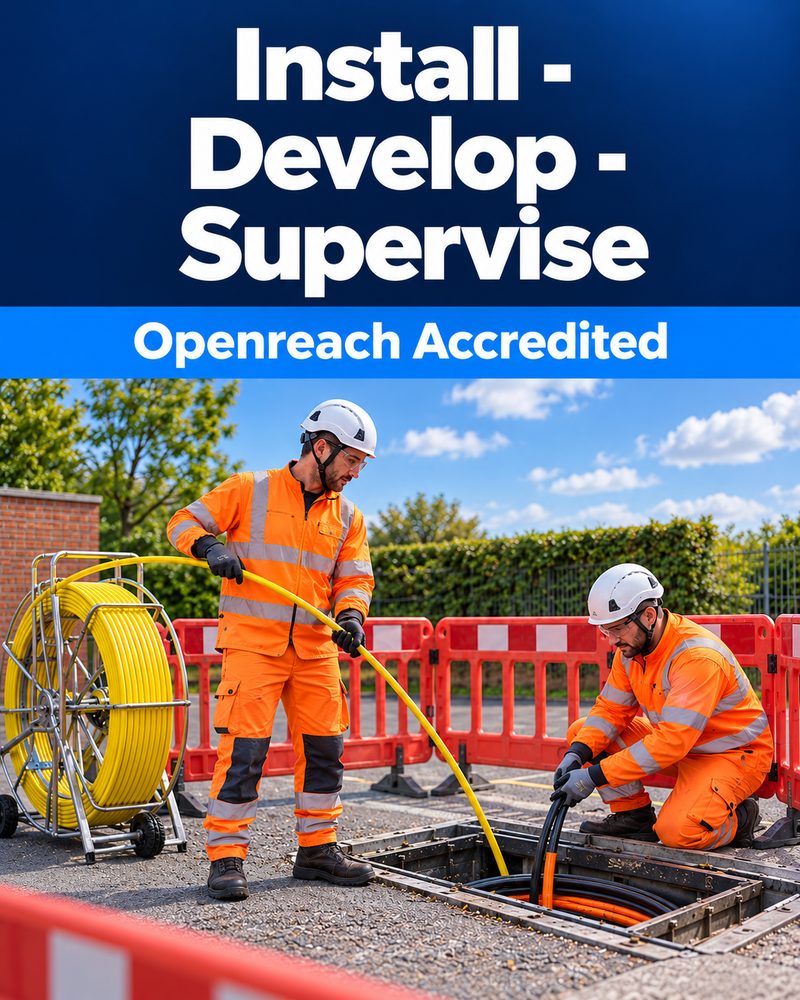
Openreach PIA S7, formally S007 – PIA Sub-Duct and Cable Installation, prepares operatives to install telecommunications cable and subduct through existing Openreach underground ducts and chambers. This two-day course covers route preparation, duct proving, installation techniques, infrastructure protection, labelling and reporting. Training combines technical instruction with practical exercises at our Crewe, Cheshire training centre. Fibre Optics Training UK is an authorised Openreach PIA training provider, helping delegates develop the knowledge and practical skills required for underground installation and the associated accreditation assessments.

Loading available course dates…
Choose your date and book
Renew your Openreach PIA accreditation
Refresh your existing Openreach PIA accreditation before it expires. Refresher training is available to eligible delegates within three months of their accreditation expiry date.
£200 + VAT
Checking available refresher dates…
Course at a glance
Theory and practical, hands-on training
2 days
Duration
Fibre Optics Training Centre
Crewe, Cheshire
CW1 6BG
Location
Underground cabling operatives and fibre installation engineers
Who it’s for
Openreach PIA S7 / S007 accreditation
Valid for three years
Qualification
What you will be able to do
By the end of the course, you should be able to:
✓ Identify Openreach underground chambers and relevant network assets, establishing the infrastructure involved in the proposed installation.
✓ Distinguish Openreach infrastructure from other providers’ apparatus and explain why asset identification matters before installation begins.
✓ Identify chamber bores and the intended underground route, relating the available infrastructure to the planned cable or subduct installation.
✓ Check duct capacity and calculate appropriate cable and subduct fill, considering existing apparatus and the proposed installation.
✓ Prepare the route for cable and subduct installation, identifying access conditions and constraints that need resolving before work proceeds.
✓ Prove duct routes using appropriate test rods and ropes, recognising resistance and other indications that require investigation.
✓ Use the installation equipment covered by the S007 programme correctly, following instructions and protecting existing network apparatus.
✓ Explain the purpose of KIT 1A and apply its correct use within the underground installation activities taught.
✓ Apply appropriate use of 25 mm duct rods and Duct Motor 2B during the relevant practical installation exercises.
✓ Install subduct up to 25 mm within existing underground ducts, maintaining control and observing the applicable PIA requirements.
✓ Install telecommunications cable through existing duct routes, guiding it carefully through chambers and maintaining its condition.
✓ Protect existing network infrastructure during installation and recognise handling methods that could damage new or existing apparatus.
✓ Identify duct blockages, gather relevant evidence and recognise when to stop work and escalate an unresolved installation problem.
✓ Record installation and route information accurately, including evidence needed for relevant A1024 reporting and subsequent review.
✓ Complete cable and subduct routing, restraint and labelling, checking the finished arrangement against the installation requirements.
Course modules and practical training
This Openreach PIA S7 course combines theory with practical underground installation, developing the route preparation, duct proving, cable and subduct handling, infrastructure protection and reporting skills needed for Physical Infrastructure Access projects.
Underground infrastructure and asset identification
Understand the infrastructure you will encounter before beginning an installation. Delegates learn to identify Openreach chambers, recognise relevant network assets and distinguish them from apparatus belonging to other communications providers. Training explains why accurate identification matters when choosing a route and protecting services already present. Practical work connects chamber identification with the bores and apparatus visible in the training environment, helping delegates approach an underground installation with a clear understanding of the assets involved and the boundaries of their task.
Chamber bores, route preparation and duct capacity
Prepare the proposed route by identifying the relevant chamber bores and checking how the installation will pass through the underground network. Delegates consider available space, existing apparatus and the cable or subduct being installed. Training includes the appropriate cable and subduct fill calculations and explains why apparent space alone is not enough to justify an installation. Practical exercises link route preparation to capacity checks, helping delegates identify constraints before feeding material into a duct or creating avoidable congestion within a chamber.
Duct proving, test rods and ropes
Learn how duct proving supports controlled cable and subduct installation. Delegates practise the appropriate test rod and rope methods used to establish whether the intended route can be used. The training connects equipment selection, careful handling and route confirmation with the protection of existing apparatus. Practical exercises help delegates recognise resistance or an unexpected obstruction and understand why these conditions require investigation. The emphasis is on establishing a usable route and recognising limitations before committing to the installation.
Installation equipment and chamber working
Understand the purpose and correct use of the equipment covered by the S7 syllabus, including KIT 1A, 25 mm duct rods and Duct Motor 2B. Delegates connect each item with the activity it supports and learn why equipment must be used appropriately within the chamber and duct environment. Practical instruction develops familiarity with the relevant setup and handling methods. Equipment use is taught alongside infrastructure protection and the need to follow instructions, rather than treating tools as a way to overcome an unresolved route problem.
Subduct installation within existing Openreach ducts
Develop the techniques used to install subduct up to 25 mm within existing Openreach underground infrastructure, in accordance with the applicable PIA requirements. Delegates consider the prepared route, material handling and the relationship between the new subduct and existing apparatus. Practical work focuses on maintaining control as the subduct passes through ducts and chambers, avoiding damage and leaving a suitable installation. Training also connects placement with the routing, restraint and identification required for a clearly managed underground network.
Telecommunications cable installation and handling
Practise installing telecommunications cable through an established underground route while maintaining its condition. Delegates learn to handle and guide cable carefully, recognise installation constraints and avoid working methods that could damage either the new cable or existing network apparatus. Practical exercises link the preparation and duct-proving stages with cable placement through the training infrastructure. The focus is on a controlled installation, suitable routing within chambers and recognising when progress should pause because the route or cable behaviour needs attention.
Blockage identification, evidence and escalation
Recognise duct blockages and other constraints that prevent an installation from continuing as planned. Delegates learn why an obstruction must be identified and reported accurately, with the relevant supporting evidence. Training distinguishes recognising and reporting a problem from undertaking work outside the operative’s task or competence. Practical scenarios connect the location of a blockage with the route information needed to explain it. Delegates also consider when to stop, protect the infrastructure and escalate the issue through the appropriate process.
Cable restraint, labels and infrastructure protection
Complete the installation with attention to how cable and subduct are routed, restrained and identified within chambers. Delegates learn why labels must be positioned correctly and why the finished arrangement should protect existing apparatus as well as the new installation. Practical work encourages a final review of handling, placement and identification rather than treating the job as complete as soon as material reaches the next chamber. This reinforces the connection between installation quality, traceability and future network maintenance.
A1024 reporting and integrated practical exercises
Understand the A1024 reporting process and the installation or route information required for the relevant submissions. Delegates connect accurate records with the work they have completed, including evidence associated with blockages and installation constraints. Integrated practical exercises bring together asset identification, route preparation, duct proving, cable and subduct installation, labels and infrastructure protection. The aim is to develop a coherent working approach and prepare delegates to demonstrate both their understanding and practical competence during the required S007 assessment activities.
On successful completion of the required knowledge and practical assessments, delegates achieve Openreach S007 – PIA Sub-Duct and Cable Installation accreditation, commonly referred to as Openreach PIA S7 Underground Cabling.
The assessments demonstrate your understanding and practical ability to prepare routes, prove ducts, install cable and subduct, protect infrastructure and complete the associated identification and reporting activities.
Delegates must successfully complete all required assessment activities. Attendance alone does not achieve accreditation, and separate competence requirements apply to specialist activities outside the course scope.
The Openreach PIA S7 / S007 accreditation is valid for three years from the date of successful completion.
Assessment and qualification
Who should attend?
This course is intended for operatives whose work involves installing telecommunications cable or subduct through existing Openreach underground infrastructure. It suits individuals building their practical installation competence and employers preparing teams for PIA network deployment. Delegates should arrive with the required underground safety qualification and be ready to participate in practical training and assessment.
Suitable roles include:
Underground cabling operatives installing telecommunications cable through existing ducts and chambers.
Fibre installation engineers working on FTTP and wider access-network deployment projects.
Subduct installation teams preparing existing duct routes for communications provider apparatus.
Telecommunications contractors undertaking underground installation within Openreach PIA infrastructure.
Communications provider engineers responsible for cable placement, identification and installation quality.
Operatives involved in duct proving, route preparation, rodding and roping activities.
Working team leaders who also carry out the installation tasks covered by S007.
Existing engineers adding underground installation competence to their current fibre network skills.
Contractors who need to understand blockage evidence, installation records and escalation procedures.
Previous cabling experience can help delegates relate the training to site work, but the published FOT entry requirements do not make it essential. Employers should select training according to the activities each operative will perform. For underground surveying, consider S006; for overhead cable installation, consider S008. Contact FOT if you are unsure which accreditation matches your responsibilities or existing qualifications.
Entry requirements
Delegates must hold a valid Smart Awards SA002 Underground Safety qualification before attending this course. A valid Network Operative Passport Scheme (NOPS) card is also compulsory. Provide details of your current qualification and NOPS card when booking so our team can check your eligibility and confirm the evidence required before attendance.
Your existing underground safety training should prepare you for the activities involved in cable and subduct installation. The S7 / S007 accreditation covers installation within existing Openreach ducts and chambers. Separate competence and authorisation requirements apply to excavation, confined space entry and other specialist activities outside the course scope.
Training includes practical work around underground telecommunications ducts and chambers, alongside both knowledge and practical assessments. You must be able to follow safety instructions, handle the relevant equipment and participate in the required activities. Tell our team about learning, accessibility or practical support needs before booking so we can discuss suitable arrangements.
Previous underground cabling experience is helpful but is not essential where the required safety qualification and valid NOPS card are held. Follow your joining instructions for arrival time, suitable clothing and the PPE you must bring. Contact FOT if you need help checking your certificates or selecting the appropriate training before attending.
Why train with Fibre Optics Training UK?
4 Great Reasons to Train With Us
1. An authorised Openreach PIA training provider
Fibre Optics Training UK is an authorised Openreach PIA training provider. Your course focuses on the underground cable and subduct installation activities associated with S007, helping you relate accreditation to network work. Guidance on scope and entry requirements helps individuals and employers choose training for the tasks their operatives perform.
2. Practical training in an underground network environment
Develop your skills through practical exercises using underground ducts, chambers and relevant installation equipment at our Crewe training centre. Work through route preparation, duct proving, cable handling and subduct installation. This gives you opportunities to connect the engineering principles with the decisions and working methods used during an installation.
3. A focus on installation quality and infrastructure protection
Learn why successful installation includes protecting existing apparatus, controlling cable handling, recognising route constraints and completing clear identification. The training connects physical installation with the records and reporting that support PIA work. Understanding these responsibilities helps you approach underground cabling methodically and recognise when a problem needs to be reported rather than worked around.
4. Guidance on your wider training pathway
Our team can help you place S007 within your development plan, whether you need underground surveying, outside plant skills or specialist installation training next. Choose related courses according to your responsibilities and existing competence. Employers can discuss team training needs, helping each delegate follow a pathway relevant to their work.
Choosing the right S7 underground installation training
Do you need to install cable and subduct in existing ducts?
Choose S007 when your work involves placing telecommunications cable or subduct within existing Openreach underground PIA infrastructure. The course connects route preparation and duct proving with installation, infrastructure protection, labelling and reporting. It is relevant to operatives carrying out these tasks, including fibre deployment teams. Check the course scope against your employer’s planned activities before booking.
Is your main responsibility underground surveying?
S006 is the more relevant course when your primary task is surveying underground infrastructure and recording route information for planning. S007 focuses on the practical installation of cable and subduct. There is some shared infrastructure knowledge, but the accreditations serve different responsibilities. Engineers carrying out both surveying and installation should discuss the appropriate combination of training with FOT.
Will you be installing cable on overhead poles?
Overhead cable installation requires a different training pathway. S008 addresses overhead cabling rather than the duct and chamber installation covered by S007. If your project includes underground and overhead sections, select training according to the tasks each operative will undertake. Contact FOT to discuss the relevant safety prerequisites and accreditations for the planned work.
Do you want specialist cable blowing skills?
Installing subduct and using air-assisted techniques to install fibre are related activities, but they involve different equipment and skills. Consider our Air Blown Fibre and Blown Cable Technology course if cable blowing is part of your role. S007 provides the underground PIA installation focus described here; specialist blowing training can support a broader installation pathway where appropriate.
Are you building a wider fibre engineering skill set?
S007 is a focused accreditation for underground PIA installation. For a wider range of fibre network tasks, consider outside plant installation, fibre splicing or advanced OTDR training according to your experience. These courses develop different capabilities and should be selected to match your work. FOT can help you identify a sensible sequence without assuming every engineer needs every course.
Career progression

Related training and equipment
Extend your practical skills
Openreach PIA S6 Underground Surveying — add underground route surveying and reporting to your practical cable installation skills.
Fibre Optic Outside Plant Installation Level 3 — extend your practical skills across external fibre network installation and testing.
Air Blown Fibre and Blown Cable Technology — explore specialist air-assisted installation training; check the course scope and entry requirements before booking.
Explore relevant equipment
Discuss duct-proving and cable or subduct handling equipment with our team. Choose equipment relevant to your underground installation tasks and existing competence. If your role also involves testing completed fibre links, ask FOT about inspection and test equipment for that separate stage of work.
Visit FOT and plan your stay
Contact FOT to arrange a Free Open Day or discuss learner support. See travel and accommodation information for attending our Crewe centre.
Training for your team
Explore corporate training for a programme shaped around your team’s experience and working requirements.
S7 / S007 underground installation FAQs
1. What is Openreach PIA S7 / S007 training?
Openreach PIA S7 is the familiar shorthand for S007 – PIA Sub-Duct and Cable Installation. The course develops the knowledge and practical skills needed to install telecommunications cable and subduct within existing Openreach underground infrastructure. It covers route preparation, duct proving, installation, protection of existing apparatus, labelling and reporting. FOT delivers the course in Crewe through technical instruction, practical exercises and the required accreditation assessment activities.
2. Does S007 include underground subduct installation?
Yes. The S7 syllabus includes installing subduct up to 25 mm within existing Openreach underground duct infrastructure. Delegates learn how route preparation, duct capacity, material handling and chamber arrangements affect installation quality. Practical training connects the physical installation with protection of existing apparatus and suitable identification. The diameter and installation method must remain within the applicable PIA requirements and the scope of the current approved course.
3. What is the difference between S006 and S007?
S006 focuses on surveying existing underground infrastructure and recording information that supports route planning. S007 focuses on installing telecommunications cable and subduct through existing underground ducts and chambers. Some infrastructure knowledge overlaps, but each accreditation addresses a different task. If your role involves both surveying and installation, ask FOT about the appropriate combination of courses. Holding one accreditation should not be treated as automatically covering the other activity.
4. How does S007 differ from S008 overhead cabling?
S007 concerns underground installation through ducts and chambers, while S008 concerns overhead cable installation on pole routes. These activities involve different infrastructure, working methods and safety requirements. S007 therefore suits underground cabling operatives rather than delegates seeking overhead installation accreditation. If your employer delivers routes containing both types of infrastructure, discuss the tasks you personally undertake with FOT so the course selection and prerequisites match your role.
5. What qualifications do I need before attending S007?
Delegates must hold a valid Smart Awards SA002 Underground Safety qualification and a valid NOPS card before attending S007. Provide your qualification and card details when booking so our team can check eligibility and explain the evidence required. Previous underground cabling experience is helpful but is not essential where these requirements are met. Contact FOT before booking if you need help checking your certificates or discussing learning support.
6. Does the course cover duct proving and blockages?
Yes. Duct proving and blockage identification form part of the S7 programme. Delegates learn the appropriate test rod and rope methods, recognise route constraints and understand the evidence needed for blockage reporting. Training also covers when work should stop or be escalated. Recognising a blockage does not mean an operative can undertake any remedial activity; the response must remain within their competence and the relevant work arrangements.
7. Which equipment and reporting processes are covered?
The syllabus includes KIT 1A, 25 mm duct rods and Duct Motor 2B alongside test rods and ropes used for duct proving. Training connects the appropriate equipment use with route preparation, installation and infrastructure protection. The programme also covers cable labels, blockage evidence and the information required for relevant A1024 reporting. Delegates learn how the physical installation and its supporting records fit together within underground PIA work.
8. How long is the course, and where is it held?
FOT’s S007 underground cabling and subduct installation course runs over two days at our training centre in Crewe, Cheshire. The location is Unit 2, First Avenue, Crewe, CW1 6BG. Training includes technical instruction and practical activities using underground network infrastructure. Choose an available date through the course booking section and check your joining instructions for arrival time, suitable clothing and the PPE you are required to bring.
9. How is S007 assessed, and what accreditation will I receive?
Delegates complete the required knowledge and practical assessments for the underground installation activities covered by the course. Successful completion leads to Openreach S007 – PIA Sub-Duct and Cable Installation accreditation. The accreditation is valid for three years from successful completion. Attendance alone does not guarantee accreditation: delegates must meet the assessment requirements. Employers should also check safety qualifications, NOPS records and project requirements before deployment.
10. Does S007 cover cable blowing, splicing or fibre testing?
S007 focuses on underground PIA cable and subduct installation, including preparation, duct proving, infrastructure protection, identification and reporting. Specialist cable blowing, fusion splicing and optical testing require their own skills and training pathways. FOT offers related courses for these areas, allowing delegates to develop a wider installation or testing role. Ask our team which programme suits your experience and intended responsibilities rather than assuming those activities are included within S007 accreditation.