
COFNII CFTE — Certified Fibre Testing Engineer
Advanced OTDR Training & Fault Finding
Move beyond automatic test results and develop confidence in diagnosing fibre network problems. This practical advanced OTDR training course helps experienced installers and engineers understand what their measurements reveal, investigate unexpected results and make informed decisions about corrective action. Build a repeatable approach to testing, troubleshooting and documenting fibre links.

Loading available course dates…
Choose your date and book
Renew your Openreach PIA accreditation
Refresh your existing Openreach PIA accreditation before it expires. Refresher training is available to eligible delegates within three months of their accreditation expiry date.
Select a refresher date to check availability.
Course at a glance
Theory and practical, hands-on training
Four days
Duration
Fibre Optics Training Centre
Crewe, Cheshire
CW1 6BG
Location
Experienced fibre installers, testing engineers and maintenance technicians.
Who it’s for
Open Awards Level 3 Award in Advanced OTDR Testing (RQF)
Qualification
What you will be able to do
By the end of the course, you should be able to:
✓ Apply relevant IEC, ISO/IEC and BS EN standards and project specifications, explaining why we test and how acceptance limits are selected.
✓ Set up testers correctly, checking instrument ports, test leads, fibre types and connector condition before measurement.
✓ Inspect, clean and reinspect connector end faces in line with IEC 61300-3-35 principles.
✓ Perform Tier 1 verification of continuity, polarity, length and insertion loss using suitable OLTS reference methods and launch conditions.
✓ Calculate link-loss budgets, interpret optical power and loss readings, and compare results with the required limits.
✓ Measure and interpret optical return loss (ORL), distinguishing whole-link ORL from individual-event reflectance.
✓ Configure OTDR wavelength, range, pulse width, averaging, refractive index and thresholds to suit the link and test requirements.
✓ Select suitable minimum launch and receive lead lengths for the settings and dead zones, and configure compensation and link boundaries.
✓ Analyse traces and event tables independently, checking automated SLM/iOLM results against the underlying measurement evidence.
✓ Place cursors for two-point section measurements and four-point LSA event-loss analysis, recognising instrument-specific measurement options.
✓ Perform bi-directional OTDR testing and event-loss averaging, explaining backscatter differences, apparent gainers and exaggerated losses.
✓ Distinguish genuine faults from ghosting, dead zones and noise, and compare wavelengths to investigate bends and excessive loss.
✓ Complete Tier 2 OTDR characterisation alongside Tier 1 results, confirm repairs by retesting, and produce clear records and handover reports.
✓ Select complementary OLTS, ORL and OTDR tests, explaining what each measurement reveals and when further investigation is needed.
✓ Explain failed results using trace evidence and acceptance criteria, then recommend corrective action and the required retests.
Course modules and practical training
This advanced OTDR training course combines theory with practical investigation, developing correct tester setup, standards-based measurements, manual trace analysis and structured fibre fault finding. Work through the testing process from inspection and reference setting to bi-directional analysis, retesting and handover.
Test planning, standards and acceptance criteria
Start with the installed link, the purpose of the test and the evidence required for commissioning or fault diagnosis. Review link records, fibre types, connection points and project specifications before choosing the test sequence. Explore ISO/IEC 14763-3, IEC 61280-4-1 and IEC 61280-4-2, relevant BS EN 50173 requirements and BS EN 50174-4. Understand how standards guide the test arrangement and why acceptance limits must suit the specified link and application.
Connector inspection, cleaning and equipment preparation
Inspect instrument ports, test leads and link connectors before taking measurements. Apply inspection principles aligned with IEC 61300-3-35, identify contamination or damage, and practise the inspect, clean and reinspect process. Check fibre type, connector compatibility and polish, and consider how poor connections affect loss, reflectance and repeatability. Prepare the test equipment and leads systematically so results describe the installed link rather than avoidable problems in the test arrangement.
Tier 1 testing, optical power and insertion loss
Work with light sources, power meters and Optical Loss Test Sets to verify continuity, polarity, length and end-to-end insertion loss as required. Distinguish optical power readings in dBm from loss measurements in dB. Select the appropriate reference method, verify test reference cords and use suitable launch conditions for the fibre type. Calculate a link-loss budget, compare measured results with the required limits and investigate unexpected or negative loss readings before accepting the test.
Optical return loss and event reflectance
Understand the difference between whole-link optical return loss and the reflectance of an individual connector or event. Explore how reflections relate to connection quality and why higher ORL indicates less light returned towards the source. Select an appropriate measurement arrangement and review the results against the project requirements. Compare ORL findings with insertion-loss measurements and OTDR traces to build a more complete picture of the link rather than treating one measurement as proof of overall performance.
Manual OTDR configuration and measurement reliability
Configure the OTDR for the link and test purpose, selecting wavelength, distance range, pulse width, averaging time and refractive index. Examine how these settings affect event resolution, dead zones, noise and the ability to reach the fibre end. Set appropriate thresholds from the relevant specification and check that the trace provides usable evidence. Compare manual analysis with automated SLM/iOLM outputs, recognising when a different configuration or additional acquisition is needed to resolve uncertainty.
Launch and receive fibres, compensation and dead zones
Select launch and receive leads with compatible fibre and connectors, using manufacturer guidance, pulse width and attenuation dead-zone behaviour to determine suitable minimum lengths. Ensure there is enough undisturbed backscatter to assess the first and last link connections. Configure lead compensation and identify the correct link boundaries. Distinguish event dead zones from attenuation dead zones and examine how closely spaced connections or strong reflections can prevent reliable loss measurement with a particular setup.
Trace interpretation and event analysis
Read the trace alongside the event table and the known construction of the link. Identify reflective and non-reflective events, connectors, splices, changes in attenuation and the fibre end. Review event location, loss and reflectance, and check that automated event identification is consistent with the underlying trace. Compare acquisitions at suitable wavelengths to investigate bends and wavelength-dependent loss. Recognise when noise or limited resolution makes an apparent result uncertain and choose the next measurement accordingly.
Two-point cursor measurements and four-point LSA
Place two-point cursors to measure distance and loss across a selected section, considering whether the interval includes connectors, splices or other events. Practise four-point event-loss analysis using least-squares approximation, selecting suitable backscatter regions on either side of the event. Understand how cursor position, disturbed trace sections and noise influence the result. Recognise that four- and five-point marker arrangements depend on the instrument and analysis mode, and follow the equipment’s measurement guidance.
Bi-directional testing and event-loss averaging
Acquire suitable traces from both ends of the link and match corresponding events before comparing results. Explore how differences in fibre backscatter can produce apparent gainers or exaggerated splice losses in one direction. Average corresponding event-loss measurements to reduce this directional bias and assess the results against the required limits. Keep acquisition settings, fibre identifiers and direction records clear so the measurements can be paired correctly and the analysis remains traceable.
Ghosting, measurement artefacts and structured fault finding
Distinguish genuine network faults from ghost reflections, dead zones, noise and incorrect event identification. Examine suspicious events using their location, trace behaviour, wavelength response and measurements from the opposite direction. Build a diagnosis from connector inspection, OLTS, ORL and OTDR evidence, deciding what to inspect or measure next. Investigate fibre breaks, bends, excessive loss and poor connections, then confirm the effect of corrective work with the appropriate retests.
Practical investigations, reporting and handover
Bring the modules together through practical investigations using OTDRs, optical loss test sets, light sources, power meters and inspection tools from manufacturers including EXFO, VIAVI, Softing and Fluke. Set up the instruments, explain the chosen configuration, analyse results and investigate introduced faults. Compile Tier 1 results and Tier 2 traces with link identifiers, test settings, findings and retest evidence. Prepare a clear handover record that another engineer can review and understand.
Assessment includes practical and knowledge-based activities covering fibre testing and fault finding. Delegates demonstrate correct equipment setup, appropriate test configuration and the interpretation of measurements against relevant standards and project requirements. The emphasis is on explaining the test method, analysing traces and results, recognising measurement limitations and presenting clear evidence for the conclusions reached.
On successful completion of the required assessments, learners receive the Open Awards Level 3 Award in Advanced OTDR Testing (RQF) – QAN 603/7804/9. The course develops the testing, analysis and documentation skills used in fibre commissioning, maintenance and network acceptance, including the ability to explain findings, identify corrective action and verify results through appropriate retesting.
Assessment and qualification
Who should attend?
This advanced OTDR training course is for installers, engineers and technicians with an existing fibre installation foundation who want to develop their testing, commissioning and fault-finding skills. It combines correct equipment setup with standards-based measurements, manual trace analysis and the documentation needed to explain and verify fibre link performance.
Suitable for:
Experienced fibre installers progressing from installation and basic testing into detailed link verification, OTDR trace interpretation and structured fault finding.
Fibre, telecoms, broadband and FTTP engineers who need to investigate unexpected losses, reflective events, bends and recurring faults in installed networks.
Commissioning and network acceptance teams responsible for reviewing Tier 1 and Tier 2 results, checking test configurations and assessing evidence against project specifications.
Maintenance technicians who want to distinguish genuine network faults from ghost reflections, dead zones, apparent gainers and other measurement effects.
Enterprise infrastructure and data centre engineers developing their use of OLTS, ORL and OTDR measurements to assess fibre connections and document link performance.
Testing engineers seeking confidence in manual instrument settings, launch and receive lead selection, cursor placement, LSA measurements and bi-directional event-loss analysis.
Supervisors and corporate engineering teams seeking consistent approaches to standards, test procedures, trace review, corrective action and commissioning records.
Choose this course for specialist fibre testing and fault finding. If you are new to fibre preparation, termination or fusion splicing, start with Fibre Optic Installation & Splicing. If you are unsure whether your experience is suitable, contact us to discuss your background and training needs.
Entry requirements
You should have existing fibre installation competence or equivalent practical experience before attending this advanced OTDR course. It is intended for learners who already understand fibre optic cabling and want to develop their testing, trace interpretation and fault-finding skills.
A working knowledge of fibre preparation, connectors, fusion splicing and basic optical testing will help you get the most from the training. If you are new to these activities, we recommend completing Fibre Optic Installation & Splicing before progressing to advanced OTDR testing.
You should be ready to take part in classroom learning, hands-on testing exercises, fault investigations and practical and knowledge-based assessments. You will work with test equipment, interpret results and explain your findings. Follow the trainer’s safety instructions and use tools and equipment as demonstrated.
If you have learning, accessibility or other support needs, contact us before booking so we can discuss your requirements and any adjustments. If you are unsure whether your experience is suitable for this Level 3 course, speak to the training team before choosing your date.
Why train with Fibre Optics Training UK?
4 Great Reasons to Train With Us
1. Learn from experienced industry trainers
Learn from trainers with practical experience in fibre optic installation, optical testing and fault finding. Their industry knowledge connects classroom theory to the decisions you face on site, from choosing suitable test settings and recognising trace events to investigating unexpected results and producing clear evidence for network handover.
2. Build confidence through hands-on training
Practise at our dedicated training centre in Crewe using professional OTDRs, optical loss test equipment and fibre inspection tools. Work through equipment setup, trace interpretation and fault-location exercises that reflect commissioning and maintenance tasks, with opportunities to investigate faults, compare measurements and explain the corrective action required.
3. Gain a Level 3 qualification in advanced OTDR testing
Successful completion of the required practical and knowledge-based assessments leads to the Open Awards Level 3 Award in Advanced OTDR Testing (RQF) – QAN 603/7804/9. This qualification provides formal recognition of your advanced testing skills, supporting progression into responsibilities involving fibre commissioning, fault investigation, network maintenance and test documentation.
4. Develop skills that transfer between equipment brands
Our manufacturer-neutral approach focuses on understanding the test method, selecting appropriate settings and interpreting the results. Explore wavelength, pulse width, range, averaging and measurement limitations to build confidence with OTDR testing, developing knowledge you can apply across compatible equipment platforms rather than relying on one instrument’s menus.
Choosing the right OTDR training
Is this the right course for my experience level?
Choose this course if you already have fibre installation competence or equivalent practical experience and want to develop advanced testing and fault-finding skills. It suits engineers involved in fibre commissioning, maintenance and network acceptance. The training develops your ability to configure test equipment, interpret OTDR traces, investigate faults and explain your findings through clear test records.
When should I choose fibre installation training or a combined bundle?
Choose Fibre Optic Installation & Splicing if you first need to develop fibre preparation, termination, fusion splicing and basic optical testing skills. If you want to progress through installation and advanced testing within one programme, consider the Fibre Optic Installation & Advanced OTDR Testing Bundle. Compare the practical scope and entry requirements with your existing experience and the work you expect to undertake.
What is the difference between attending and qualifying?
Attending develops your knowledge and practical skills through guided testing exercises and fault investigations. Achieving the Open Awards Level 3 Award in Advanced OTDR Testing (RQF) requires successful completion of the required practical and knowledge-based assessments. See Assessment and qualification for the award details and the evidence you will be expected to demonstrate.
Can I visit before deciding?
Visit FOT through a Free Open Day to see the training facilities and discuss your experience, career plans and training needs. The public course takes place at the Fibre Optics Training Centre in Crewe, Cheshire, CW1 6BG. If you are choosing training for a team, contact us to discuss corporate delivery and the testing or fault-finding skills your engineers need.
How does advanced OTDR training support my next step?
Advanced OTDR training builds on existing fibre skills and supports progression into work involving commissioning, network maintenance, fault investigation and test documentation. You can present your qualification alongside practical experience when discussing your capabilities with employers or clients. Contact the training team to discuss how this course fits your current role and the responsibilities you want to develop.
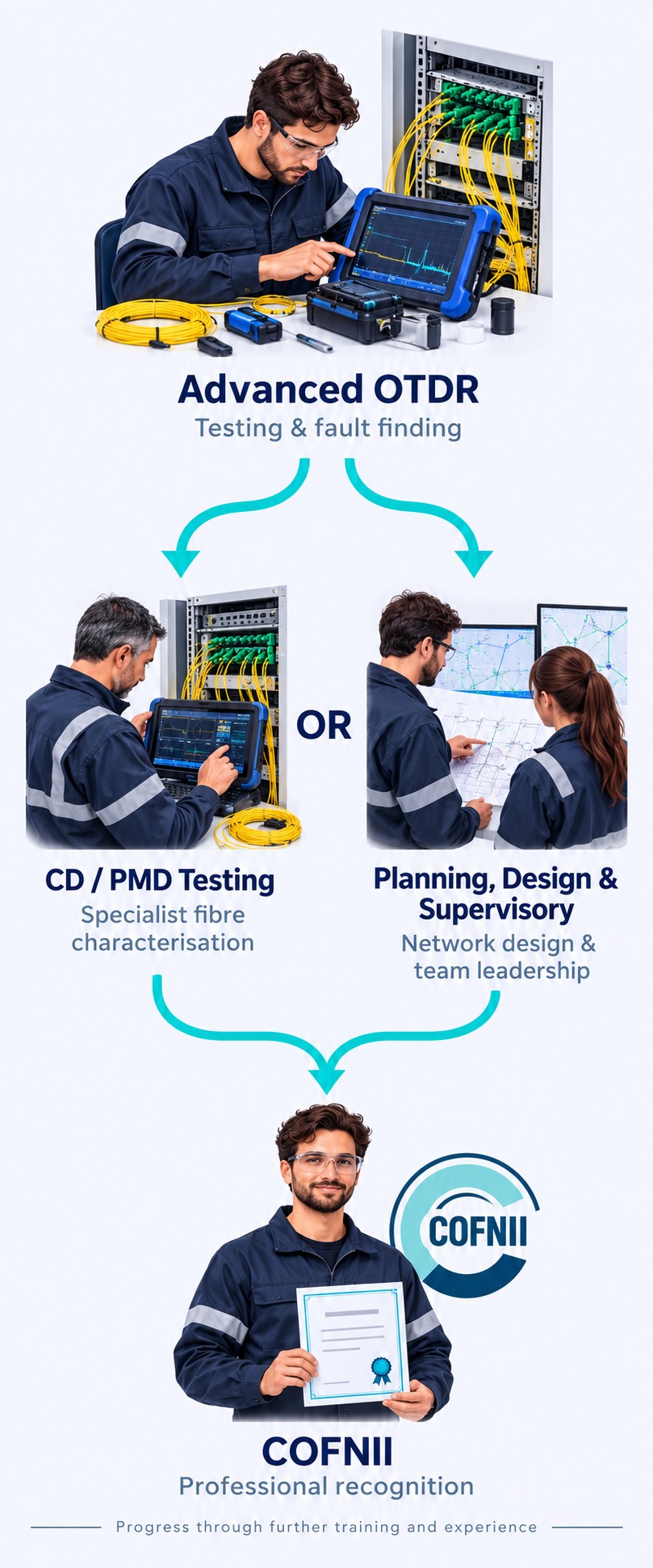
Career progression

Related training and equipment
Extend your practical skills
CD / PMD testing — discuss specialist chromatic dispersion and polarisation mode dispersion training with our team to extend your fibre characterisation skills.
Fibre Optic Planning & Design — develop the planning and design knowledge that supports progression towards network design and supervisory responsibilities.
Fibre Optic Installation & Splicing — strengthen fibre preparation, fusion splicing and installation skills alongside advanced testing; check the course scope and entry requirements before booking.
Explore relevant equipment
Discuss professional OTDRs, optical loss testers, fibre inspection tools and launch and receive leads with our team. Consider the fibre types, wavelengths, dynamic range and reporting capabilities needed for your work, along with suitable adapters, reference leads and analysis software. Contact FOT for equipment guidance. Course teaching remains manufacturer-neutral.
Visit FOT and plan your stay
Contact FOT to arrange a Free Open Day or discuss learner support. See travel and accommodation information for attending our Crewe centre.
Training for your team
Explore corporate training for a programme shaped around your team’s experience and working requirements.
Advanced OTDR course FAQs
1. What does OTDR stand for and what does it measure?
OTDR stands for Optical Time Domain Reflectometer. It sends pulses of light into a fibre and analyses the returned signal to produce a trace of events along its length. An OTDR helps locate connections, splices, bends and breaks, and assess their loss or reflectance. You learn to interpret these measurements while recognising the instrument’s settings, dead zones and measurement limitations.
2. What makes this a practical advanced OTDR course?
The course combines classroom learning with hands-on optical testing, trace analysis and fault investigations. You configure professional test equipment, investigate unexpected results and choose further tests to support your diagnosis. The emphasis is on understanding the measurement, explaining the evidence and deciding what to do next, including corrective action, retesting and preparing clear records for commissioning or network handover.
3. Do I need previous fibre optic or OTDR experience?
You should have existing fibre installation competence or equivalent practical experience before attending. A working knowledge of fibre preparation, connectors, fusion splicing and basic optical testing will help you get the most from the course. Previous advanced OTDR experience is not essential. If you are new to fibre work, consider Fibre Optic Installation & Splicing first or contact us to discuss your starting point.
4. Will I learn to configure an OTDR and interpret traces?
Yes. You learn to select wavelength, range, pulse width, averaging, refractive index and thresholds to suit the link and test requirements. Practical exercises develop your understanding of launch and receive leads, link boundaries, dead zones, event tables and trace interpretation. You investigate apparent gainers, reflective events, bends and other unexpected results, explaining what the evidence supports and when further testing is needed.
5. Why test a fibre from both directions?
Different backscatter characteristics in adjoining fibres can make a splice appear to have excessive loss in one direction or an apparent gain in the other. Comparing and averaging suitable measurements from both directions helps assess the splice loss more accurately. You learn to match events, recognise measurement limitations and use bidirectional results alongside other evidence when investigating or accepting a fibre link.
6. Does an OTDR replace an optical loss test set?
No. An optical loss test set measures end-to-end insertion loss, while an OTDR helps locate and characterise individual events along the fibre. The measurements answer different questions, and a project may require both. Training connects Tier 1 optical loss testing with Tier 2 OTDR analysis, helping you select suitable test methods, compare results with project requirements and investigate inconsistencies before recording your conclusions.
7. How is the course assessed?
Assessment includes practical tasks and knowledge-based activities covering equipment setup, test configuration, trace interpretation and fibre fault finding. You demonstrate that you can apply the methods taught, analyse results and explain the evidence supporting your conclusions. Opportunities to practise are provided before assessment. Successful completion depends on meeting the assessment requirements; contact us before booking to discuss learning or accessibility support.
8. What qualification will I receive?
Successful completion of the required practical and knowledge-based assessments leads to the Open Awards Level 3 Award in Advanced OTDR Testing (RQF) – QAN 603/7804/9. The qualification recognises the advanced testing skills demonstrated through assessment. These skills support work involving fibre commissioning, maintenance, fault investigation and test documentation. See Assessment and qualification for further details of the award and the assessment activities.
9. Where does training take place and how long does it last?
The public course lasts four days at the Fibre Optics Training Centre, Unit 2, First Avenue, Crewe, Cheshire, CW1 6BG. Training combines classroom learning with practical optical testing and fault-finding exercises. Travel and accommodation information is available for learners attending the centre. Corporate delivery can also be discussed for client sites across the UK, Europe and the Middle East, according to your team’s requirements.
10. How do I book a place or arrange corporate training?
Choose an available course date in the booking section, or use the course enquiry button to discuss availability and booking options. For corporate training, tell us your team size, experience, location and the testing tasks your engineers need to perform. If you are deciding between installation training, advanced OTDR or a combined bundle, contact the training team or arrange a Free Open Day before choosing.