
S008 Overhead Cable Installation Training
Openreach PIA S008 Overhead Cabling
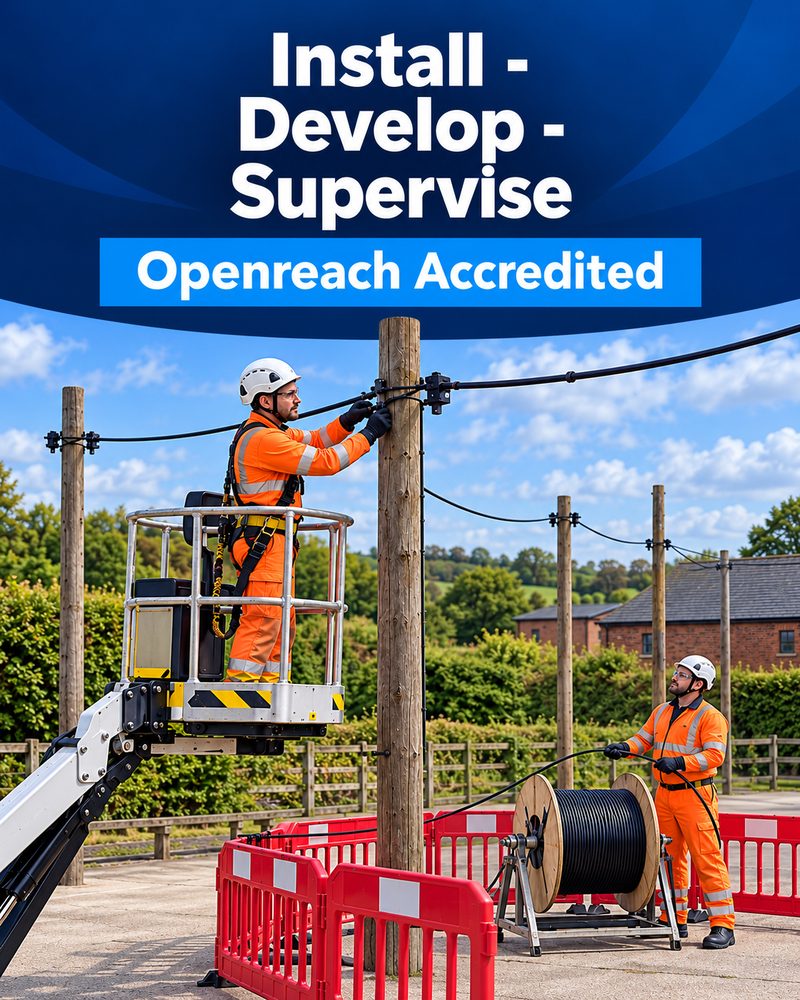
Openreach PIA S8 training develops the knowledge and practical skills needed to install telecommunications cable on existing Openreach overhead infrastructure. The formal accreditation is S008 – PIA Overhead Cable Installation. Delegates learn about pole assets, available space, cable spanning, drop-wire installation, DILOR requirements and protection of existing apparatus. Training combines technical instruction with practical overhead installation exercises at Fibre Optics Training UK's centre in Crewe, Cheshire. As an authorised Openreach PIA training provider, we help operatives prepare for the required knowledge and practical assessments.

Loading available course dates…
Choose your date and book
Renew your Openreach PIA accreditation
Refresh your existing Openreach PIA accreditation before it expires. Refresher training is available to eligible delegates within three months of their accreditation expiry date.
£250 + VAT
Checking available refresher dates…
Course at a glance
Theory and practical, hands-on training
3 days
Duration
Fibre Optics Training Centre
Crewe, Cheshire
CW1 6BG
Location
Overhead cabling engineers and contractors
Who it’s for
Openreach PIA S8 / S008 accreditation
Valid for three years
Qualification
What you will be able to do
By the end of the course, you should be able to:
✓ Identify existing overhead network assets and recognise the apparatus relevant to an installation.
✓ Interpret pole types, classifications and markings when deciding whether planned work can proceed.
✓ Apply the required pole pre-use checks before accessing or using overhead infrastructure.
✓ Assess available pole space and recognise restrictions affecting additional cable or equipment.
✓ Identify suitable positions for CP termination equipment within the permitted pole space.
✓ Prepare an overhead installation task using the relevant route information and safe working arrangements.
✓ Apply appropriate methods for installing telecommunications cable between poles.
✓ Understand road-crossing requirements and check cable heights using suitable measuring equipment.
✓ Apply the engineering techniques covered for deploying drop cable up to 7 mm in diameter.
✓ Explain Dropwire In Line of Route requirements and their relevance to the planned installation.
✓ Select and apply the cable attachment methods covered by the approved training programme.
✓ Route, restrain and protect cable while preserving climbing areas and access to existing apparatus.
✓ Recognise constraints that may require a network adjustment or escalation before installation continues.
✓ Understand whereabouts records and the required process for reporting damage or A1024 defects.
✓ Demonstrate the knowledge and practical competence required for the S008 installation assessment.
Course modules and practical training
This Openreach PIA S8 course combines theory with practical overhead installation, developing the pole checks, space assessment, cable spanning, drop-wire installation, infrastructure protection and reporting skills needed for Physical Infrastructure Access projects.
Pole assets, types and classifications
Identify the poles and existing apparatus involved in an overhead installation. Delegates consider how pole type, classification and markings affect the proposed task, including the distinctions between Light, Medium, Stout and Hollow poles. Recognising an asset is the starting point for deciding how it may be used. Training relates these observations to installation decisions and the need to recognise conditions that require clarification or escalation before additional cable or equipment is fitted.
Site preparation and pole pre-use checks
Connect preparation of the work area with the checks required before accessing or using a pole. Delegates consider the site-specific circumstances, condition of the infrastructure and the access method relevant to their task. The course reinforces the importance of applying existing safety competence throughout installation. Practical preparation brings together the work area, required equipment and pole checks so the activity begins with a clear understanding of the conditions and applicable controls.
Available pole space and termination equipment
Understand how existing apparatus and permitted installation space affect the position of new equipment. Delegates consider the placement of communications provider termination nodes, including the connector equipment identified in FOT's programme. Training connects space assessment with correct positioning and continued access to existing assets. Practical activities help delegates relate the proposed installation to the pole arrangement, rather than assuming an apparently empty area is automatically suitable for additional equipment or cable.
Cable spanning and road crossings
Develop an understanding of the methods used to install telecommunications cable between poles, including the road-crossing activities covered by the assessment scope. Delegates connect the selected route with span requirements and the checks needed for the finished cable arrangement. Suitable measuring equipment is used for the relevant height checks. The emphasis is on applying the approved installation method and checking its result, with decisions guided by the current engineering requirements taught during training.
Drop-wire installation and DILOR
Learn the engineering techniques covered for installing drop cable up to 7 mm in diameter within the overhead infrastructure. Delegates examine Dropwire In Line of Route requirements and consider how the proposed wire relates to the existing route. Training links these requirements with practical installation choices and protection of the surrounding network. The objective is to understand both the physical task and the constraints that determine whether the intended arrangement is appropriate for the infrastructure.
Cable fittings, attachments and customer fixings
Understand the attachment arrangements covered by the installation programme, including the appropriate use of cable clamps and the relevant pole or customer fixing. Delegates relate the fitting to the cable and the installation method being used. Practical work reinforces correct positioning and application rather than treating different fittings as interchangeable. The course also connects the completed attachment with the need to preserve the condition of the cable and the infrastructure supporting it.
Cable routing, restraint and infrastructure protection
Consider how cable is routed and secured on the pole after the span or connection has been installed. Delegates learn why positioning must protect the new cable while maintaining the climbing area and access to existing apparatus. Training connects cable restraint and protection with a review of the completed arrangement. Practical activities encourage delegates to check the overall result, including how their installation affects other equipment, rather than judging completion solely by whether a cable has reached its destination.
Installation constraints and network adjustments
Recognise conditions that may prevent the planned installation from proceeding as intended. Delegates connect available space, pole classification and route constraints with the need to seek guidance or a network adjustment. The course distinguishes identifying a problem from undertaking additional work outside the assigned task or competence. Practical discussion encourages an appropriate response when the installation cannot meet the applicable requirements, helping delegates understand when to stop and escalate rather than improvise an unsupported solution.
Whereabouts, damage and defect reporting
Understand how the installation task relates to the required whereabouts information and reporting of damage or A1024 defects. Delegates consider why records should accurately identify the activity and any issue requiring attention. Training connects reporting responsibilities with infrastructure protection and the decisions made during the work. These topics support a complete installation workflow, while the exact submission process and current notice requirements are explained using the applicable course documents and communications provider arrangements.
Integrated practical installation exercises
Bring the supported topics together in overhead installation scenarios. Delegates practise relating pole and asset checks to the available installation space, cable deployment, attachments and the finished arrangement. Practical exercises support preparation for the required assessment by connecting individual techniques with the complete task. The emphasis remains on applying the methods correctly, protecting the existing network and explaining relevant decisions. The assessment configuration follows the current approved S008 module used by FOT's assessor.
Delegates complete a knowledge assessment and practical installation assessment. Both parts must be successfully completed to achieve the accreditation.
Assessment checks understanding of the relevant PIA requirements and the ability to apply overhead installation methods safely, correctly and with appropriate protection of existing apparatus.
Successful delegates achieve Openreach S008 – PIA Overhead Cable Installation accreditation. S8 is the familiar course name; S008 is the formal accreditation code. Attendance alone does not demonstrate a successful assessment outcome.
The accreditation is valid for three years from successful completion. Employers should also check each operative's current safety qualifications, NOPS record and task requirements before assigning work.
Assessment and qualification
Who should attend?
This course is intended for people whose responsibilities include installing telecommunications cable on existing Openreach overhead infrastructure. It suits communications provider engineers and contractors working on pole routes, including fibre and FTTP deployment teams. The emphasis is on the installation task: understanding the infrastructure, applying the appropriate methods and demonstrating practical competence within the S008 scope.
This course is suitable for:
Telecommunications engineers installing cable between existing poles on Openreach PIA routes.
Fibre installation operatives responsible for overhead sections of a network build.
FTTP deployment engineers undertaking drop-wire installation and customer connection activities within the course scope.
Communications provider contractors who require the relevant overhead installation accreditation.
Cabling team members preparing routes and installing cable alongside existing network apparatus.
Engineers whose duties include positioning the termination equipment covered by the overhead installation programme.
Experienced overhead operatives who need to demonstrate their installation competence through the required assessments.
Employers arranging consistent, task-specific training for engineers carrying out overhead PIA installation work.
Previous cabling experience can help you relate the training to site work, but it is not essential. You must already meet the applicable safety prerequisites. If you mainly survey pole routes, work in underground ducts or need additional pole-stepping competence, discuss those responsibilities with our team so your course selection matches the tasks assigned by your employer.
Entry requirements
Delegates must hold a valid Smart Awards SA001 Overhead Safety qualification and a valid NOPS card before attending. Both are compulsory for this course. Provide your current qualification and card details when booking so our training team can check eligibility and confirm the evidence required before attendance.
SA051C TETRA Leaning Ladder and Flat Roof or SA054C TETRA Leaning Ladder competence is beneficial, but neither is required to attend S8. These awards have defined access scopes and do not replace the compulsory SA001 qualification. Tell our team about any existing TETRA accreditation when discussing your training needs.
You should be ready to participate in classroom learning, practical overhead installation activities and both knowledge and practical assessments. Follow the trainer’s safe working instructions and bring the PPE, appropriate clothing and personal equipment specified in your joining instructions. Previous overhead cabling experience is helpful, but is not essential where the entry requirements are met.
Contact our team before booking if you need help checking certificates, confirming NOPS status or selecting the appropriate PIA course. If you have learning, accessibility or practical support needs, tell us in advance so we can discuss your requirements and suitable arrangements for training and assessment.
Why train with Fibre Optics Training UK?
4 Great Reasons to Train With Us
1. Authorised Openreach PIA training provider
Fibre Optics Training UK is an authorised Openreach PIA training provider. Our S8 programme focuses on the overhead installation knowledge and practical competence associated with S008 accreditation. Delegates can discuss their intended role and existing qualifications with our team before booking, helping them select the relevant training and prepare for attendance.
2. Practical overhead installation training
Learn through technical instruction and practical exercises using overhead training infrastructure at our Crewe centre. The programme connects the installation task with the checks and decisions that support it. Delegates have opportunities to apply course methods, understand why they matter and prepare to demonstrate competence during the required assessment activities.
3. A clear focus on your installation role
S8 content concentrates on installing overhead cable and protecting the infrastructure around it. Course guidance explains how this responsibility differs from overhead surveying and underground installation. That distinction helps individual engineers and employers choose a training pathway that reflects the work involved, particularly when teams undertake several types of network activity.
4. Support with your next training step
Our team can help you check course suitability and discuss related safety, surveying and fibre installation training. Whether you are booking independently or arranging places for colleagues, you can ask about prerequisites and practical attendance requirements. Further courses can then be selected according to your experience and the responsibilities of your role.
Choosing the right S8 overhead installation training
Do you need to install cable on existing Openreach poles?
S8 is the relevant option when your task is overhead cable installation within the S008 scope. The course connects pole and route information with practical installation methods, equipment positioning and protection of existing apparatus. Tell FOT which activities your employer expects you to undertake so we can check the course and entry requirements against that role before you book.
Is your main responsibility overhead surveying?
S005 overhead surveying serves a different responsibility: examining existing overhead infrastructure and gathering information for planning. S008 focuses on installation. There is shared knowledge of poles and routes, but an installation accreditation should not be treated as a surveying accreditation. If you carry out both tasks, discuss the appropriate combination with FOT and check the prerequisites for each course separately.
Will you be installing underground cable or subduct?
Choose S007 for underground cable and subduct installation within the relevant PIA scope. S8 concerns overhead infrastructure, so it does not replace the underground installation pathway. Projects may include both types of route, but the training should follow the work each operative performs. FOT can help you compare the courses and identify the safety evidence needed for the intended activities.
Does your work involve congested poles or specialist access?
Discuss the exact activity before booking. Pole stepping on congested poles is addressed by the separate S009 programme. SA051C or SA054C TETRA competence is beneficial but is not required to attend S8. Additional training should match your wider working duties and access equipment. Provide your existing certificates and describe the planned work so FOT can advise on the relevant course combination and its requirements.
Do you also need splicing or optical testing skills?
Overhead cable installation is one part of a wider fibre network role. Splicing, optical testing and fault-finding require their own skills and training pathways. Consider suitable fibre installation or advanced OTDR training if those duties form part of your work. Our team can help you select the next step according to your experience, rather than assuming these subjects are included in S008 accreditation.
Career progression

Related training and equipment
Extend your practical skills
Openreach PIA S5 Overhead Surveying — add pole surveying and route assessment to your overhead cable installation skills.
Openreach PIA S9 Pole Stepping — explore the separate pole-stepping course where your working duties require this competence.
Fibre Optic Outside Plant Installation Level 3 — develop broader external fibre installation skills; check the course scope and entry requirements before booking.
Explore relevant equipment
Discuss overhead cable installation equipment with our team. Check your joining instructions for the PPE and personal equipment you must bring. If your wider role includes fibre splicing or optical testing, ask FOT about suitable equipment and the separate training needed for those activities.
Visit FOT and plan your stay
Contact FOT to arrange a Free Open Day or discuss learner support. See travel and accommodation information for attending our Crewe centre.
Training for your team
Explore corporate training for a programme shaped around your team’s experience and working requirements.
S8 / S008 overhead cabling FAQs
1. What is Openreach PIA S8 training?
Openreach PIA S8 is the familiar name for training leading to S008 – PIA Overhead Cable Installation accreditation. It develops the knowledge and practical competence needed to install telecommunications cable on existing Openreach overhead infrastructure. Delegates study the relevant installation requirements and apply them through practical exercises. FOT delivers the course at its Crewe training centre, with successful accreditation dependent on completing the required knowledge and practical assessments.
2. What overhead installation activities does the course cover?
The S8 programme covers pole asset identification, available pole space, cable spanning, road crossings, drop-wire installation, DILOR requirements, pole classifications, network adjustments and infrastructure protection. Training connects these subjects with practical installation decisions and the finished cable arrangement. The current approved assessment module determines the activities delegates must demonstrate. If your employer requires a particular installation method or equipment configuration, discuss it with FOT before booking your place.
3. How does S008 differ from S005 overhead surveying?
S005 concerns overhead surveying: examining existing infrastructure and gathering information that supports planning. S008 concerns installing overhead cable and associated apparatus within its accreditation scope. Both involve understanding poles and routes, but they serve different job responsibilities. Choose the course that matches your assigned task. If you undertake both surveying and installation, speak to FOT about the appropriate training combination and check the entry requirements for each programme separately.
4. How does S008 differ from S007 underground installation?
S008 covers overhead cable installation on existing pole infrastructure. S007 covers underground cable and subduct installation through existing ducts and chambers. The working environments, methods and safety prerequisites differ, even where both activities form part of one network build. Holding an overhead installation accreditation does not replace the underground pathway. Tell FOT which route sections and tasks you undertake so we can help you select the relevant training programmes.
5. What safety qualification and NOPS evidence do I need?
Delegates must hold a valid Smart Awards SA001 Overhead Safety qualification and a valid NOPS card before attending S8. Both are compulsory. Provide your current qualification and registration details when booking so FOT can check eligibility and explain the evidence needed. SA051C or SA054C TETRA competence is beneficial but is not an entry requirement for this course. Contact our team if you need help checking certificates or discussing support.
6. Is TETRA accreditation required before attending S8?
No. SA051C or SA054C TETRA competence is beneficial, but neither is required to attend FOT’s S8 course. SA001 Overhead Safety and a valid NOPS card remain compulsory. SA051C covers leaning ladder and flat roof, SA054C covers leaning ladder only, and SA053C covers leaning ladder and enhanced flat roof. Their access scopes differ, so discuss the award appropriate to your wider working duties with our training team.
7. Does S8 cover DILOR and installation reporting?
Yes. DILOR, meaning Dropwire In Line of Route, is included in the S8 syllabus. The Openreach assessment scope also addresses whereabouts information and the process for reporting damage or A1024 defects. These responsibilities connect the physical installation with the records and escalation needed around it. Delegates learn how accurate reporting supports the work completed and how to recognise issues that need attention through the relevant process.
8. How long is the course, and where is it held?
The S8 course runs over three days at its training centre in Crewe, Cheshire. The address is Unit 2, First Avenue, Crewe, CW1 6BG. Training combines technical instruction with practical overhead installation activities and assessment. Select a suitable date in the booking section, then read your joining instructions for arrival arrangements, appropriate clothing, required PPE and any personally supplied equipment you need to bring for practical participation.
9. How is S008 assessed, and how long is accreditation valid?
S008 includes both a knowledge assessment and practical assessment of overhead installation competence. Delegates must successfully complete the required activities to achieve Openreach S008 – PIA Overhead Cable Installation accreditation. The accreditation is valid for three years from successful completion. The assessor uses the current approved assessment requirements. Employers should also check the operative's safety qualifications, NOPS record and suitability for the specific work being assigned.
10. Does S8 include pole stepping, splicing or OTDR testing?
S8 focuses on overhead cable installation within the S008 accreditation scope. Pole stepping on congested poles is addressed by the separate S009 course, while fibre splicing and OTDR testing have their own training pathways. Choose additional programmes according to the duties you undertake and their entry requirements. Related courses or equipment displayed on this page should not be interpreted as confirmation that those separate activities are included in S008 assessment.