
INTERNATIONAL FIBRE OPTIC, OTDR & DATA CABLING TRAINING
Fibre Optic & Data Cabling Training in Madrid
Fibre Optics Training provides practical fibre optic, structured data cabling and network infrastructure training for engineers, telecoms contractors and organisations in Madrid and across Spain.
We can arrange tailored corporate training at client premises in Madrid and other suitable locations in Spain, subject to a minimum of four delegates. Topics can include fibre optic installation, fusion splicing, OTDR testing, optical loss testing, fault finding, structured cabling, copper certification and network infrastructure skills.
Individual learners and teams can also attend scheduled courses at our specialist training centre in Crewe, Cheshire, United Kingdom. Contact Fibre Optics Training to discuss course availability, suitable programmes and delivery arrangements for Madrid and the wider Community of Madrid area.
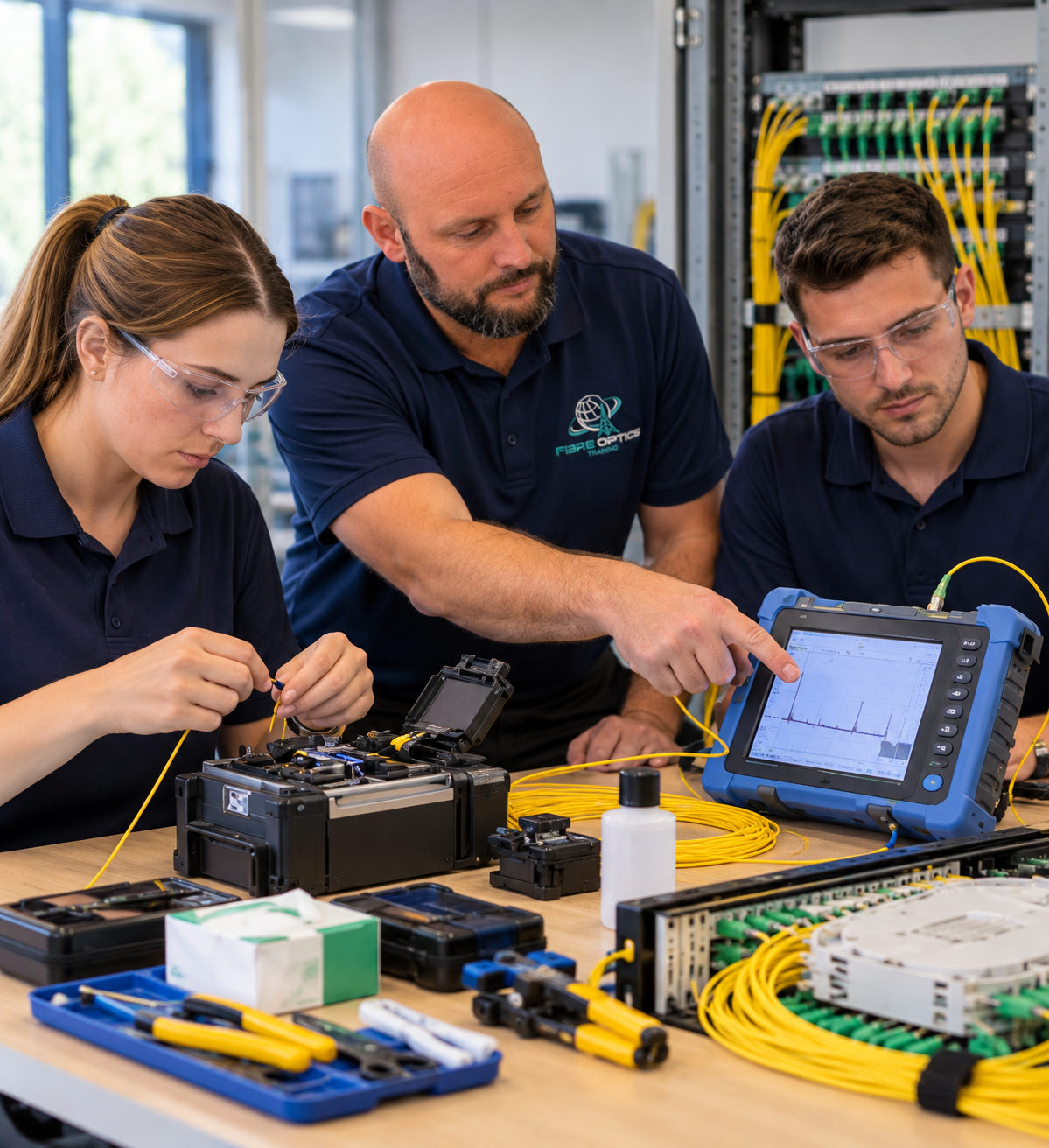
International training at a glance
Delivery
Tailored, instructor-led practical training. Duration depends on the programme; onsite delivery from four delegates.
Location
At a suitable client site in Madrid or elsewhere in Spain. Scheduled UK courses run in Crewe.
Who it's for
Fibre engineers, telecommunications teams, network installers, contractors and employers requiring technical skills.
Qualifications
Course-dependent certificates and qualifications. Confirm recognition, eligibility and local requirements before booking.
Fibre Optic, OTDR & Data Cabling Training Available for Madrid
Installation and fusion splicing
For projects involving data centre patching, enterprise network resilience and optical backbone acceptance, technicians may need to handle fibre types, preparation methods, bend management, cable identification and splice protection correctly. The installation component can cover safe work practices, fibre preparation, cleaving, jointing and connector inspection; the corporate syllabus is selected against actual job duties rather than a generic list.
Optical loss and advanced OTDR testing
Teams can progress from optical power meter and light-source techniques to test set-up, link loss budgets, test cords, OTDR pulse width and range selection, dead zones, reflective events, splice loss estimation and event tables. A tailored advanced programme can place particular emphasis on optical loss-budget validation and coordinated cabling documentation. Engineers should understand that OTDR trace evidence and insertion-loss measurement are complementary rather than interchangeable.
Structured data cabling and network infrastructure
Training can include copper cabling pathways, handling, termination, labelling, field certification, optical backbone installation, connector cleaning and record quality. Depending on project scope, instructors may reference ISO/IEC 11801, BS EN 50173/50174, ISO/IEC 14763-3 and applicable IEC 61280 procedures. The precise standard parts and editions must match the actual technical brief.
Custom employer programmes
Employers can combine modules appropriate to staff experience, equipment and relevant project documentation. Advanced OTDR, fibre fault finding, data centre cabling or structured cabling design can be emphasised where appropriate. Published accredited programmes and customised professional development must be separately identified; no new qualifications are implied by customisation.
Practical activities can be selected from stripping, cleaning, precision cleaving, fusion splicing, patch-panel or fibre-management work, inspection of connector end faces, light-source and power-meter measurement and OTDR testing. Technicians should learn what a test result means, not merely how to press a measurement button.
For Madrid corporate groups, the equipment plan needs to be checked with the employer. Relevant demonstration equipment may include optical test sets and splicing tools; references to EXFO, VIAVI or Sumitomo do not imply manufacturer certification or endorsement. Assessment evidence and custody of equipment should be agreed in advance. Sample reports related to optical loss-budget validation and coordinated cabling documentation may help instructors adapt exercises without exposing commercially sensitive network data.
For Madrid teams, supervised practical tasks can also be organised around a coherent testing and fault-finding workflow: inspect and clean connector end faces, establish the test configuration, record optical power or insertion-loss results, review OTDR traces and document the suspected source of any abnormal event. Engineers can compare test records with the project specification and practise communicating findings in a clear handover report. The specific exercises, instruments and acceptance criteria are confirmed during course planning; a demonstration alone does not certify a customer installation.
Who the training is for
The typical audience in Madrid includes data centre fit-out teams, network designers and testing technicians. Supervisors may focus on test records, quality checks and installation acceptance; technicians may require repeatable procedures for preparation, splicing, cleaning and measurement. New starters may benefit from installation foundations before moving into advanced fault analysis.
Employers planning data centre patching, enterprise network resilience and optical backbone acceptance can identify the specific tasks for which their teams need evidence of competence. This might involve responding to failed test results, improving field documentation, reducing avoidable connector contamination or better understanding optical backbone design. Our aim is to agree learning outcomes relevant to the organisation rather than suggest unverified local projects or customers.
For companies operating in Madrid, the corporate process starts by reviewing technical tasks, learner numbers, baseline competence and expected performance after training. We then discuss which installation, splicing, testing, documentation or structured-cabling modules are appropriate. Teams facing data centre patching, enterprise network resilience and optical backbone acceptance may want a concentrated practical session around optical loss-budget validation and coordinated cabling documentation.
Onsite delivery normally requires at least four delegates and is conditional on an agreed schedule, trainer availability, suitable working space, appropriate health and safety arrangements, equipment access and commercial terms. International travel or logistics are not guaranteed until confirmed. Training the team at its own facilities may reduce employee travel and accommodation costs compared with UK attendance, although no fixed saving is promised.
The enquiry should state project specifications and whether a formal qualification is required. Where an Open Awards route is proposed, international assessment permission and evidence capture require specific confirmation before booking.
Fibre Optics Training provides eligible programmes linked to Open Awards vocational qualifications, including fibre installation and testing and relevant advanced OTDR learning pathways. A qualification has defined assessment and awarding requirements; a custom corporate attendance certificate is not equivalent. For a cohort taught in Spain, confirm whether the exact qualification may be delivered and assessed under the awarding-body arrangements before promising an award.
Fibre Optics Training is a COFNII Approved Training Provider. COFNII professional recognition pathways can be explored by eligible individuals internationally where the relevant requirements are satisfied. Provider approval, individual certification, manufacturer training and national legal permissions are separate matters. Neither Open Awards nor COFNII recognition creates automatic professional licensing or guaranteed recognition in Spain.
Instruction can be informed by ISO/IEC 11801 and ISO/IEC 14763-3:2024 for generic and optical cabling considerations, and IEC 61280-4-2:2024 for installed single-mode measurements. BS EN 50173 and 50174 can be referenced where applicable to a project brief. Local requirements, contractual specifications and the current relevant part/edition take precedence over broad marketing descriptions.
Why choose Fibre Optics Training?
Fibre Optics Training combines practical technical instruction with training pathways intended for installation, testing and maintenance roles. Employers can seek an integrated programme from fibre preparation and fusion splicing through to advanced OTDR event interpretation, structured cabling principles and traceable acceptance documentation.
The training centre in Crewe supports scheduled UK teaching. Corporate groups in Madrid can instead discuss practical onsite arrangements for four or more delegates, including equipment access and required outcomes. The distinction between assessed Open Awards programmes, possible COFNII recognition and non-award tailored sessions is explained during planning so expectations remain accurate.
Fibre Optics Training can agree a suitable balance of instructor explanation, supervised workshop time and assessment for a Madrid-based employer. Delegates can focus on the processes they actually use, from preparation and fusion splicing to trace interpretation and structured cabling test records. Organisations considering onsite tuition should supply the intended delegate number, role profiles, project objectives and suitable training facilities. International delivery requires agreement in advance and starts at a minimum of four delegates.
For tailored fibre optic, advanced OTDR or structured cabling training for your Madrid team, please use the corporate training enquiry form. Tell Fibre Optics Training your delegate numbers, technical requirements, preferred delivery location, relevant equipment and expected outcomes.
Onsite corporate training normally requires at least four delegates and is subject to suitable facilities, travel, trainer availability and agreed arrangements. Scheduled UK courses are held at our Crewe, Cheshire training centre.
In your enquiry, identify whether your Madrid team is looking for introductory fibre skills, advanced OTDR fault finding, structured copper cabling or a blended programme. Tell us whether the training needs to support a particular equipment type or technical standard, and whether a formal qualification is being considered. We will clarify any requirements, likely delivery format and assessment arrangements before you make a booking decision.
Fibre Optic and Data Cabling Training Across Madrid
Fibre Optics Training supports engineers, contractors and employers seeking training in Madrid, Spain and nearby communities, including Alcobendas, San Sebastián de los Reyes, Getafe, Leganés, Fuenlabrada, Pozuelo de Alarcón, Las Rozas, Alcalá de Henares and across the wider Madrid metropolitan area and Central Spain.
For individual learners and smaller groups in Madrid, our scheduled practical fibre optic and data cabling courses are delivered at our specialist training centre in Crewe, Cheshire, United Kingdom. We do not operate a permanent training centre in Madrid.
Our training covers fibre optic installation and fusion splicing, OTDR testing and fault finding, optical loss testing, structured data cabling, copper certification and relevant network infrastructure skills. Course selection depends on existing experience, technical responsibilities and project requirements.
Employers in Madrid and neighbouring areas can discuss tailored on-site programmes for four or more delegates at suitable client premises. International delivery is subject to trainer availability, safe facilities, equipment and travel arrangements, and any applicable course or qualification requirements.
Fibre Optic & Data Cabling Training in Madrid: FAQs
1. Can Fibre Optics Training deliver training at our Madrid workplace?
Potentially, yes. We offer onsite group training for at least four delegates subject to agreed programme requirements, trainer availability and suitable facilities. Contact us with your team size, equipment and location so that the proposed delivery arrangements can be assessed. There is no permanent Fibre Optics Training establishment in Madrid. We first review the team's technical objectives, the facilities available for supervised practical work and the tools that need to be provided. Onsite delivery depends on an agreed programme and suitable arrangements, rather than a permanently staffed local training venue. Individuals can also enquire about scheduled instruction at our Crewe, Cheshire training centre in the United Kingdom.
2. What is the minimum number of delegates for a Madrid corporate programme?
The usual minimum for onsite corporate delivery is four delegates. For smaller teams, consider scheduled UK courses at the training centre in Crewe. Dates, any international travel expenses, trainer availability and practical equipment requirements are confirmed during the enquiry process, not assumed on this location page. For an effective proposal, please identify whether participants are beginners, installers, test engineers or supervisors, and whether they require assessments or a tailored skills workshop. Group size, the amount of equipment needed, instructor travel and site safety arrangements all influence duration and cost. A smaller team can enquire about joining a suitable scheduled course in Crewe instead.
3. Can an OTDR course be tailored to data centre patching, enterprise network resilience and optical backbone acceptance?
Yes. The technical scope can be discussed around link length, fibre type, test limits, launch/receive fibres, event tables, loss measurements and trace interpretation. The final teaching plan depends on the learners’ starting competence and available equipment. Advanced OTDR is not the same as a basic continuity test. A tailored practical programme may include correct use of launch and receive leads, fibre inspection and cleaning, test wavelengths, reference procedures, event tables, reflective and non-reflective events, and loss-budget checks. We distinguish OTDR trace interpretation from end-to-end insertion-loss measurement; both may be relevant to acceptance criteria. The exact exercises are agreed with the employer and depend on delegates' existing test experience.
4. Will staff practise fibre fusion splicing rather than only watch demonstrations?
The practical teaching approach covers fibre preparation, stripping, cleaning, cleaving, splicing, protective sleeves and appropriate handling of splice trays where relevant to the chosen programme. Confirm the exact amount of practical time, group equipment access and assessment requirements when arranging a corporate session. Participants can discuss safe fibre preparation, precision cleaving, splice alignment, heat-shrink protection, joint closure management and the effects of contamination or poor handling. Where suitable equipment and access are provided, the instructor can give feedback on the quality and repeatability of trainees' results. Practical assessment arrangements depend on the particular programme and must be confirmed rather than presumed from attendance.
5. What structured data cabling skills can Madrid teams cover?
Training can address copper cable pathways, termination, labelling, classification, certification measurements, optical backbone cabling and as-built records. Relevant reference standards may include ISO/IEC 11801 and BS EN 50173/50174, depending on scope. Training to a standard does not independently certify an installed cabling system. Programmes can address copper cable pathways, termination, outlet and patch-panel identification, installed link testing, troubleshooting and record-keeping, alongside optical backbone handling and testing. The actual mix depends on whether the team supports offices, campuses, data centres or other customer infrastructure. Referenced standards and test limits should be selected against the client's specification; training itself does not certify a completed installation.
6. Are Open Awards qualifications available to delegates in Spain?
Fibre Optics Training offers eligible programmes linked to Open Awards vocational qualifications. Whether a specific regulated qualification can be taught, assessed and awarded for an international corporate group must be confirmed against awarding-body arrangements and the agreed delivery format. A course attendance certificate must not be described as an Open Awards qualification. Open Awards qualifications are vocational awards with specific learning outcomes, assessment and evidence requirements, not simply certificates for attending a course. For international corporate delivery, we would check whether the selected course and assessment arrangements meet the awarding body's requirements before promising an award. Local acceptance or equivalence is a separate matter that employers and learners should confirm with the appropriate authorities.
7. Is COFNII recognition available to engineers in Madrid?
Fibre Optics Training is a COFNII Approved Training Provider. Relevant COFNII professional pathways may be open to eligible individuals internationally, subject to membership, assessment and programme requirements. Participation in a course does not automatically give every learner a professional designation, nor does it grant local licensing authority. Fibre Optics Training is a COFNII Approved Training Provider. Eligibility for any individual COFNII designation depends on the relevant recognition route and its criteria; it should not be confused with automatic certification gained by attending a course. We can help explain how course outcomes and appropriate evidence may contribute to a professional development pathway, while local professional or regulatory permissions remain separate.
8. Does an Open Awards qualification automatically transfer to Spain?
No. An employer or competent national body may consider a UK vocational qualification, but equivalence, acceptance and regulated professional rights are not automatic. Learners should verify their intended use and any local recognition requirement before booking assessment. We can explain the proposed qualification and its evidence requirements. A UK vocational qualification can provide useful evidence of training and assessed competence, but it is not an automatic substitute for a local licence, registration or nationally recognised equivalent. Any employer, awarding body or competent authority may apply its own requirements. We recommend identifying the intended purpose of the qualification before booking so that training, assessment evidence and recognition expectations are agreed correctly.
9. Which technical standards are used for Madrid fibre and network cabling training?
Programmes can refer, as appropriate, to ISO/IEC 11801 for generic cabling, ISO/IEC 14763-3 for optical testing, relevant IEC 61280 measurement procedures and British/European BS EN 50173 and BS EN 50174 documents. The correct edition, part and contractual applicability should be established for the customer project; BS EN standards are not automatically legal requirements in this country. Depending on the technical scope, programmes may reference ISO/IEC 11801, ISO/IEC 14763-3, BS EN 50173, BS EN 50174 and relevant parts of the IEC 61280-4 series. The applicable edition, measurement configuration and test criteria must be selected for the customer's installation and contractual specification. British and European standards should not be presented as automatically mandatory in every international location.
10. How can a Madrid employer request a tailored fibre training proposal?
Send us your workforce size, experience, main technical tasks, preferred location, desired dates and the equipment you use. For teams responsible for optical loss-budget validation and coordinated cabling documentation, sharing a sample specification or redacted test report can help define learning objectives. We will assess suitable content and practical resources before confirming an offer. Include the number and experience of delegates, preferred delivery arrangements, required dates, technical scope and whether formal assessment is needed. If the project includes fibre acceptance testing or structured cabling, a non-confidential installation specification or example of the tests performed can help us identify suitable learning outcomes. Any proposed overseas delivery, fees, equipment and qualification arrangements will be confirmed before a booking.