
INTERNATIONAL FIBRE OPTIC, OTDR & DATA CABLING TRAINING
Fibre Optic & Data Cabling Training in Abu Dhabi
Fibre Optics Training provides practical fibre optic, structured data cabling and network infrastructure training for engineers, telecoms contractors and organisations in Abu Dhabi and across United Arab Emirates.
We can arrange tailored corporate training at client premises in Abu Dhabi and other suitable locations in United Arab Emirates, subject to a minimum of four delegates. Topics can include fibre optic installation, fusion splicing, OTDR testing, optical loss testing, fault finding, structured cabling, copper certification and network infrastructure skills.
Individual learners and teams can also attend scheduled courses at our specialist training centre in Crewe, Cheshire, United Kingdom. Contact Fibre Optics Training to discuss course availability, suitable programmes and delivery arrangements for Abu Dhabi and the wider Abu Dhabi area.
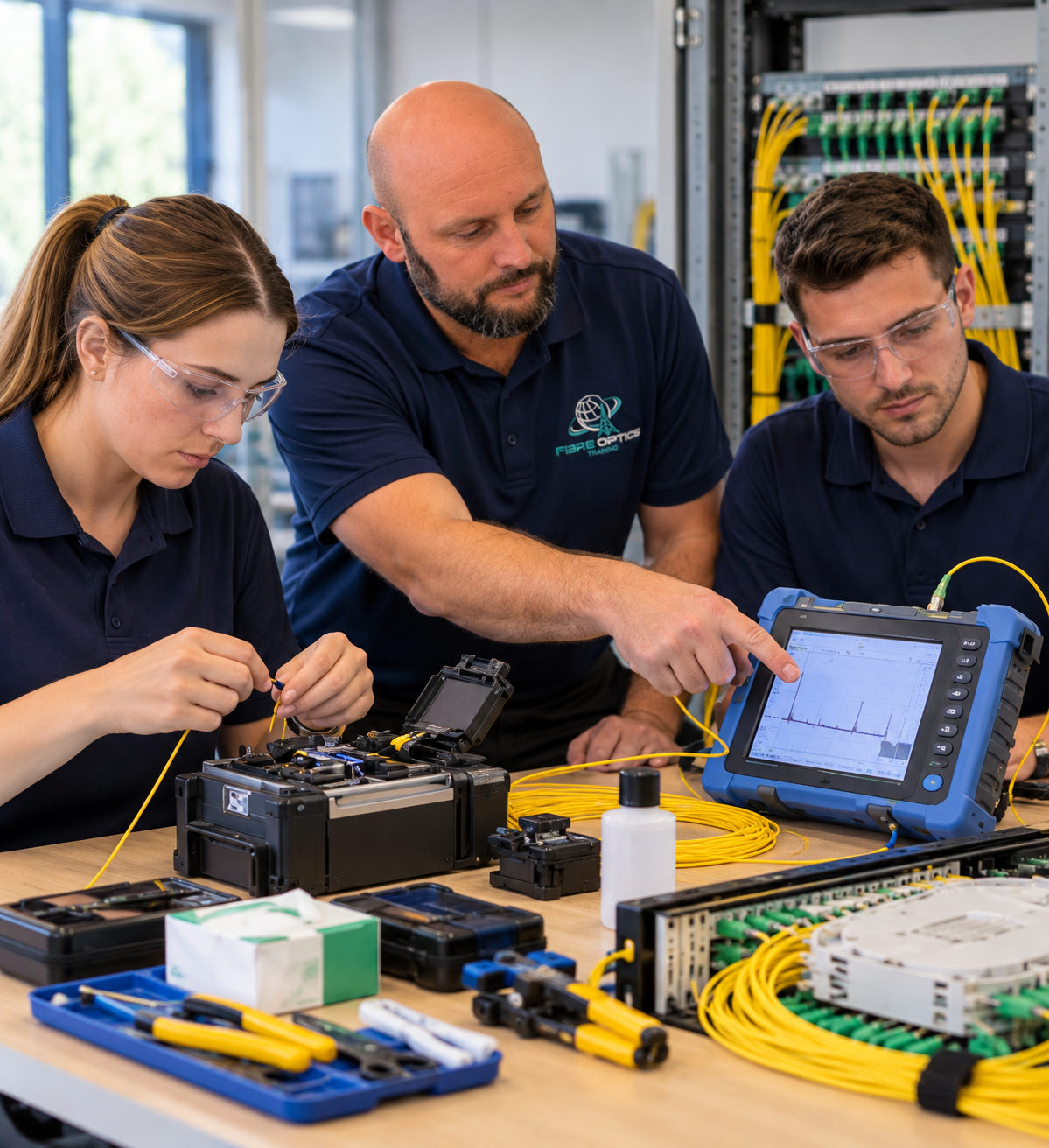
International training at a glance
Delivery
Tailored, instructor-led practical training. Duration depends on the programme; onsite delivery from four delegates.
Location
At a suitable client site in Abu Dhabi or elsewhere in United Arab Emirates. Scheduled UK courses run in Crewe.
Who it's for
Fibre engineers, telecommunications teams, network installers, contractors and employers requiring technical skills.
Qualifications
Course-dependent certificates and qualifications. Confirm recognition, eligibility and local requirements before booking.
Fibre Optic, OTDR & Data Cabling Training Available in Abu Dhabi
Fibre optic installation and fusion splicing
Corporate training can cover cable preparation, safe handling, fibre identification, stripping and cleaning, cleaving, fusion splicing, splice protection and enclosure management. Learners practise following a methodical workflow, inspecting their workmanship and producing traceable records. Practical exercises can be adapted to common single-mode installation scenarios and customer-specific construction practices. The emphasis is on repeatability and avoiding contamination or fibre damage rather than simply achieving one successful splice.
OTDR testing, optical loss and fault finding
OTDR sessions explore launch and receive leads, wavelength selection, acquisition settings, event tables, reflection, attenuation, dead zones and the interpretation of fibre traces. Advanced fault-finding exercises can examine splice losses, connector events, macro-bends, broken fibres, misleading traces and the benefit of bidirectional measurements where the specification requires them. Tier 1 loss testing and inspection are treated as complementary activities rather than substitutes for OTDR testing.
Structured data cabling and data-centre infrastructure
Where relevant to the team, programmes can address copper cable installation, termination principles, link identification, testing and certification evidence, as well as fibre pathways, patching and polarity management in enterprise and data-centre environments. Training can relate installation choices to generic cabling architecture in ISO/IEC 11801 and appropriate planning and installation practice in BS EN 50173 and BS EN 50174. The applicability of each standard depends on the installation, contractual requirements and local rules.
Tailored technical programmes
Clients can request combined modules covering fibre installation, splicing, advanced OTDR, inspection and structured cabling quality assurance. Course scope, duration, equipment and assessments are confirmed during planning; an adapted corporate syllabus does not automatically become an independently accredited qualification.
Practical fibre optics, data cabling and OTDR training
Practical exercises form the centre of the learning experience. Depending on the agreed programme, participants can work with fibre preparation tools, cleavers, fusion splicers, optical power meters, light sources, inspection tools and OTDR instruments. Activities may include connector examination, cleaning, test-cord handling, trace acquisition and the interpretation of losses, reflections and fibre events. Learners should also understand instrument setup and basic quality-control checks before recording results.
For fibre installation, the trainer can demonstrate how preparation choices affect splice quality and why contamination, bend radius and fibre routing matter. For fault-finding, trainees can compare example traces and identify when a measurement needs further investigation or additional testing. Structured cabling sessions can cover link identification and the interpretation of certification outputs where the appropriate equipment is available.
Fibre Optics Training uses specialist technical equipment in its programmes; references to EXFO, VIAVI or Sumitomo should only appear on a final page where the particular instruments or relationship are confirmed for that course. Equipment available at an overseas customer site, training consumables, power and workspace must be agreed before delivery. Training does not confer a manufacturer's certification unless separately authorised.
Who the training is for
Programmes are designed for employers who need their teams to work more consistently on optical and structured cabling infrastructure. Fibre installers may need basic fibre handling, termination and fusion splicing, while experienced technicians may require stronger interpretation of OTDR results, reporting or fault isolation. Enterprise cabling teams can focus on copper certification and optical link testing, with training scenarios aligned to the networks they support.
Supervisors and quality-assurance staff may benefit from learning how to assess installation records, spot incomplete test documentation and distinguish a passing test from a robust acceptance process. Project teams responsible for data centres, industrial networks, campuses and commercial facilities can discuss the cabling architectures and work practices relevant to their environments. These are examples of potential applications, not claims that Fibre Optics Training has delivered projects to particular Abu Dhabi organisations.
Training can be scoped for mixed-experience groups where learning objectives are realistic. An initial discussion helps establish delegates’ experience, tools, preferred language of delivery, safety arrangements, site access and desired evidence of competence. The aim is to provide practical instruction the team can apply to its own equipment and work processes.
Training at Crewe or at your premises
Our international corporate service begins with a discussion about the team's current competence, the network technologies in use and the skills the employer wants delegates to demonstrate. The outcome may be a focused advanced OTDR programme, a fusion splicing and quality-assurance course, structured cabling training or a combined technical syllabus. We can adapt the balance between explanation, demonstration, supervised practice and assessment to the learners' starting point and realistic delivery time.
Onsite corporate training normally requires a minimum of four delegates. Availability in Abu Dhabi depends on trainer scheduling, agreed travel arrangements, safe and suitable premises, equipment, consumables and any site rules or local compliance requirements. Before confirming delivery, we agree the proposed learning objectives, delegate numbers, prerequisites, practical facilities and what evidence or certificates can be issued.
Training at the employer's facility can avoid sending an entire team to the UK and may reduce time away from projects. However, employers should compare a written onsite proposal with attendance at scheduled public courses in Crewe, including costs of equipment, travel and accommodation. There is no assumed overseas classroom or immediately bookable public course in Abu Dhabi.
Qualifications, assessment and recognition
Eligible Fibre Optics Training programmes can lead to Open Awards vocational qualifications, including relevant Level 3 pathways in fibre optic installation and testing and advanced OTDR. These are UK qualifications based on defined learning outcomes and assessment requirements, not simply certificates of attendance. The exact qualification, prerequisites, assessment evidence and whether awarding-body arrangements permit assessment during international delivery must be confirmed before a corporate programme is booked.
Fibre Optics Training is a COFNII Approved Training Provider. COFNII professional recognition pathways are open to eligible applicants internationally, subject to the requirements of the relevant recognition scheme. A learner's course attendance does not automatically award COFNII professional certification. COFNII recognition, an Open Awards vocational qualification and any national licensing or equivalence decision are separate matters.
Standards-led training can cover relevant principles of ISO/IEC 11801 for generic structured cabling, BS EN 50173 for generic cabling systems and BS EN 50174 for cabling installation planning and practices. Fibre testing modules may also refer to ISO/IEC 14763-3 and applicable IEC 61280-4 series measurement methods. Specific parts, editions and test requirements depend on the programme and project specification. Training to a technical standard is not itself independent certification of an installation or an ISO qualification.
For Abu Dhabi employers, the most suitable learning and recognition pathway depends on the technical work being undertaken, delegate experience, customer specifications and any local employer or regulatory requirements. Recognition of UK vocational awards outside the UK should be checked with the relevant organisation; automatic equivalence cannot be guaranteed. We can discuss suitable assessments and documentation when tailoring the programme.
Why choose Fibre Optics Training?
Fibre Optics Training provides practical, instructor-led teaching centred on the skills technicians need for fibre optic installation, fusion splicing, optical testing, advanced OTDR interpretation and structured data cabling. Training activities can be adapted to delegate experience and the technical tasks a corporate team is expected to carry out, with supervised practice and clear learning outcomes.
For eligible programmes, learners may work towards Open Awards vocational qualifications, subject to the specific programme, assessment requirements and approval for the proposed delivery arrangements. Fibre Optics Training is also a COFNII Approved Training Provider. Relevant COFNII professional recognition pathways are open to eligible applicants internationally, but recognition is not automatic and should not be confused with local licensing or qualification equivalence.
Our technical instruction can draw on relevant principles from ISO/IEC 11801, BS EN 50173, BS EN 50174 and appropriate optical fibre testing standards. For organisations in Abu Dhabi, programmes may be arranged at suitable client premises for groups of at least four delegates, subject to agreed facilities, equipment, trainer availability and travel arrangements. Alternatively, suitable scheduled courses may be attended at our specialist training centre in Crewe, Cheshire.
Discuss your team’s training requirements
Planning practical fibre optic, advanced OTDR or structured cabling training for your team in Abu Dhabi? Tell Fibre Optics Training what technical skills your organisation needs, the preferred training location and the experience of your delegates. We can discuss a tailored syllabus for installation, fusion splicing, fibre testing, fault finding or enterprise cabling.
Onsite corporate training is available from a minimum of four delegates, subject to agreed facilities, trainer availability and delivery arrangements. Use the enquiry form to outline your delegate numbers and requirements; we will discuss suitable programme options and any relevant assessment or qualification arrangements before confirming delivery.
Fibre Optic and Data Cabling Training Across Abu Dhabi
Fibre Optics Training supports engineers, contractors and employers seeking training in Abu Dhabi, United Arab Emirates and nearby communities, including Yas Island, Khalifa City, Mussafah, Masdar City, Al Reem Island, Al Maryah Island, Al Raha, Al Ain and across the Abu Dhabi Emirate and wider UAE.
For individual learners and smaller groups in Abu Dhabi, our scheduled practical fibre optic and data cabling courses are delivered at our specialist training centre in Crewe, Cheshire, United Kingdom. We do not operate a permanent training centre in Abu Dhabi.
Our training covers fibre optic installation and fusion splicing, OTDR testing and fault finding, optical loss testing, structured data cabling, copper certification and relevant network infrastructure skills. Course selection depends on existing experience, technical responsibilities and project requirements.
Employers in Abu Dhabi and neighbouring areas can discuss tailored on-site programmes for four or more delegates at suitable client premises. International delivery is subject to trainer availability, safe facilities, equipment and travel arrangements, and any applicable course or qualification requirements.
Fibre Optic & Data Cabling Training in Abu Dhabi: FAQs
1. Where can employers in Abu Dhabi arrange fibre optic and OTDR training?
Fibre Optics Training can discuss instructor-led corporate programmes at suitable client premises in Abu Dhabi, subject to trainer availability, safe facilities, equipment requirements and agreed travel arrangements. Onsite delivery normally starts at four delegates. We do not operate a permanent training centre in Abu Dhabi. Individuals and smaller groups can enquire about scheduled courses at our specialist training centre in Crewe, Cheshire, United Kingdom. The most practical delivery option depends on delegate numbers, the technical syllabus and the equipment needed.
2. Which fibre optic installation and fusion splicing skills can our Abu Dhabi team learn?
Suitable programmes can cover optical fibre preparation, safe handling, stripping, cleaning, cleaving, fusion splicing, splice protection and enclosure management. Practical learning can also include connector inspection, fibre identification, test documentation and the effect of workmanship on optical performance. A corporate course can be tailored to the types of installation and maintenance work your engineers carry out. We agree prerequisites, equipment, practical exercises and assessment requirements before confirming an onsite programme.
3. Can Fibre Optics Training deliver advanced OTDR and fibre fault-finding training in Abu Dhabi?
Yes, subject to suitable arrangements for international onsite delivery. Advanced OTDR content can include instrument configuration, launch and receive fibres, wavelengths, event tables, attenuation, reflectance, dead zones and trace interpretation. Practical troubleshooting can explore connector faults, poor splices, bends, breaks and ambiguous events. Where relevant to a specification, training may explain the value of bidirectional measurement and how OTDR results complement optical loss testing and end-face inspection. The syllabus can be matched to delegates' experience.
4. Is structured copper and fibre data cabling training available for UAE enterprise and data-centre teams?
Fibre Optics Training can discuss customised instruction for enterprise networks, campuses and data-centre cabling environments. Depending on the programme, subjects may include copper cable installation and termination, fibre backbone infrastructure, patching, polarity management, link identification, test reporting and the interpretation of certification results. Relevant principles from ISO/IEC 11801 and BS EN 50173 or BS EN 50174 can be explained where they apply to the client's technical specification. The training scope is agreed rather than assumed to be a fixed local course.
5. How many delegates are required for onsite corporate training in Abu Dhabi?
Our normal minimum is four delegates for training delivered at a client's premises. This enables an employer to arrange practical instruction for a team without necessarily sending everyone to the United Kingdom. Before quoting, we discuss delegate numbers, existing skills, required modules, course duration, available workspace, safe access, power supply and suitable equipment. International trainer travel and logistical arrangements are subject to confirmation. Organisations with fewer than four delegates can enquire about appropriate scheduled UK training opportunities.
6. Can an Abu Dhabi employer request a customised course based on its network projects?
Yes. The programme can be scoped around the work your team is expected to perform, such as fibre installation, fusion splicing, OTDR fault location, optical acceptance testing or structured cabling quality assurance. We can discuss current network technologies, delegate experience, technical standards, reporting expectations and the amount of supervised practice required. Bespoke content does not automatically confer an externally awarded qualification; assessment and certificate arrangements must be agreed separately before the course is confirmed.
7. Can international learners obtain Open Awards vocational qualifications?
Eligible Fibre Optics Training programmes include pathways to relevant Open Awards vocational qualifications, including applicable Level 3 fibre installation, testing and advanced OTDR learning outcomes. These are distinct from a simple attendance certificate. Whether a specific award and its assessment can be delivered during an international onsite programme must be checked against the awarding body's requirements and the arrangements approved for that course. Recognition or equivalence in the UAE is not automatic; learners and employers should check applicable local requirements.
8. Is COFNII recognition available to fibre optic and structured cabling professionals in the UAE?
Fibre Optics Training is a COFNII Approved Training Provider. COFNII professional recognition pathways are open to eligible applicants internationally, including those based in the UAE, subject to the relevant scheme's criteria, assessment and approval. Course attendance alone does not necessarily grant a COFNII professional designation. We can explain the training and evidence that may support a suitable pathway, while distinguishing COFNII recognition from Open Awards qualifications and any professional or regulatory requirements imposed locally.
9. Which fibre optic and structured cabling standards are covered in the training?
Programmes can address relevant principles from ISO/IEC 11801 for generic cabling, BS EN 50173 for generic cabling systems and BS EN 50174 for installation planning and practices. Optical fibre testing may draw on ISO/IEC 14763-3 and applicable IEC 61280-4 measurement methods. The applicable part, edition and test acceptance criteria depend on the actual course and contract specification. British and European standards must not be assumed to be mandatory throughout the UAE, and training to standards is not itself third-party certification of an installation.
10. How do we enquire about corporate training or attend a course in Crewe from Abu Dhabi?
Use the training enquiry form to provide your organisation's name, Abu Dhabi or other preferred delivery location, type of training, number of delegates and a description of the skills required. Fibre Optics Training can then discuss programme options, prerequisites, equipment and proposed arrangements. For individuals or teams preferring UK delivery, we can also discuss scheduled courses at our Crewe, Cheshire training centre. Availability, course dates, fees, travel and any qualification arrangements should all be confirmed before booking.